


Forbidden City Beijing Guide: Tickets, Entrance & My Walking Route
I’ve visited the Forbidden City twice, once on my own and once with a guide. Both were memorable, but they felt like two very different visits. Here’s the route I settled on, how the tickets work, and the parts I missed the first time.
My first visit was all about the great halls. They were enormous, crowded and impressive, and I kept walking north thinking the next one must be the most important. By the end, several had blurred together. On my second visit I spent four hours with a guide called Mei. She explained how the spaces were used and why so many details mattered. I began paying attention to the smaller courtyards as much as the grand architecture.
The practical side is just as important: you need a ticket booked in advance, you enter from the south, and you leave from the north or east. Get those three things right and the visit is much easier to enjoy.
The route in one sentence: enter through Meridian Gate, see the three great ceremonial halls, move into the Inner Court, turn off into at least one smaller palace area, walk through the Imperial Garden and leave by Shenwumen for the view from Jingshan Park.
Is a Guided Forbidden City Tour Worth It?
I normally enjoy visiting historical places independently. That’s how I saw the Forbidden City the first time, and there’s nothing difficult about following the main path once you are inside. The problem was that I was seeing the buildings without understanding much about how the palace worked.
Mei changed that. During our four-hour walk she connected the public ceremonial halls with the more private parts of imperial life and pointed out architectural details I had passed without noticing. It wasn’t a matter of seeing more buildings. I got more out of the ones we saw.
If Chinese history interests you, a guided visit is money well spent. If you’re primarily there to photograph the architecture and wander at your own pace, an independent visit is perfectly reasonable. The walking route below works for both.
Forbidden City Tour (Group or Private) with Tickets Included
This is the kind of guided visit that made such a difference on my return. Choose a group or private option, with admission included in the selected package, and spend the time understanding the imperial city rather than searching for explanations on your phone.
- Guided palace visit with historical context
- Group and private booking options
- Check admission, meeting point, language and itinerary for your selected date
Affiliate link: I may earn a commission if you book, at no additional cost to you. Guides, meeting points and inclusions depend on the selected tour option; Mei was my guide, not a guaranteed guide for future bookings.

Forbidden City Tickets: Booking as a Foreign Visitor
The Forbidden City is the Palace Museum (故宫博物院), and tickets are not something to leave until the morning you arrive. The museum uses real-name reservations tied to your ID, with tickets released seven days before the visit at 20:00 Beijing time. Its published rules do not provide normal same-day ticket sales.
The easiest place to start is the official Palace Museum ticket website. It has an English option, and international visitors can register with an email address and book using their passport details. This is a useful improvement over older advice that sends everyone straight to a Chinese-only WeChat mini-program.
How to book Forbidden City tickets
- Open the official booking site and switch to English.
- Sign in using your email and the verification code sent to it.
- Select a date within the seven-day booking window and choose the admission session available.
- Enter each visitor’s name and passport details exactly as they appear on the passport.
- Add the Treasure Gallery or Gallery of Clocks only if you genuinely want the extra galleries.
- Complete payment or follow the payment instructions shown by the booking system, then keep the confirmation and bring the original passport.
The museum has also listed [email protected] as a contact for international visitor reservations. If you need that route, check the latest instructions on the museum’s own English ticket information page rather than relying on an old forum post. The online booking system is the more direct starting point.
| Forbidden City ticket | Official admission price | When it applies |
|---|---|---|
| Main admission, peak season | ¥60 | April 1 to October 31 |
| Main admission, low season | ¥40 | November 1 to March 31 |
| Treasure Gallery | +¥10 | Optional; add to your booking |
| Gallery of Clocks | +¥10 | Optional; add to your booking |
Ticket rules, prices, available exhibitions and opening arrangements should be checked on the official museum website before the visit. A third-party tour with admission included is a separate guided service, not the official standard admission price.
Can foreigners buy tickets at the gate?
You may come across accounts of visitors being helped at the foreign visitor service window without a prior booking. Those reports exist, but the museum’s written rules still say there are no normal same-day tickets. I wouldn’t turn up relying on a walk-in exception, especially if I only had a few days in Beijing.
A guided tour can take the reservation work off your hands, but it doesn’t eliminate security checks or make sold-out dates magically available. Confirm that admission is included in the exact tour option before paying.

Which Entrance to Use at the Forbidden City
The Meridian Gate (午门, Wumen) on the south side is the public visitor entrance. The large northern gate may appear closer to your hotel on the map, but it is an exit. Donghuamen on the eastern side is also an exit, not an alternative place to begin the visit.
The palace visit is essentially south to north. Decide where you want to finish before you book a car or arrange to meet anyone afterwards.
Do you have to go through Tiananmen Square?
No. You can reach the palace entrance without visiting Tiananmen Square itself. From the east, one possible approach is towards Donghuamen and then around the palace moat to Meridian Gate. The route may still involve checkpoints and temporary access controls, particularly around major events. Follow the on-site directions rather than assuming a route shown by your map app will be open.
If you want to visit the square, do it deliberately and allow time for its separate entry procedures. My Tiananmen Square guide covers the reservation and security arrangements. Otherwise, aim directly for the museum entrance. This is one occasion when simply telling a driver “Forbidden City” is not precise enough.

Finish at Shenwumen (north)
The Gate of Divine Prowess (神武门) is my preferred exit. Jingshan Park is directly across the road, so the palace visit ends with the best view of everything you have just walked through.
Finish at Donghuamen (east)
The East Prosperity Gate (东华门) works when your next stop is east of the palace. Just remember that once you have left the museum, you cannot re-enter using the same ticket.


If you are arriving by metro or Didi, my Beijing transport guide covers the transport systems and payment setup I used around the capital. Arriving in Beijing from overseas? The Beijing airport-to-city guide explains the difference between Capital and Daxing airport transfers.
Forbidden City Opening Hours and Best Time to Visit
| Season | Opening hours | Last admission |
|---|---|---|
| April to October | 08:30–17:00 | 16:00 |
| November to March | 08:30–16:30 | 15:30 |
| Mondays | Generally closed | Exceptions for certain statutory holidays |
Morning gives you the longest margin for wandering. Even with an early start, the main axis won’t be empty. But the palace gets more tiring when the central courtyards fill up and you still have several hours of walking ahead.
Afternoon light can be lovely on the red walls and roofs, but a late arrival makes less sense if you want the side palaces as well. The final entry time is not an invitation to begin a relaxed three-hour visit.
One detail worth checking when you book: the official ticketing system distinguishes morning and afternoon admission sessions, with its own check-in arrangements. Go by the instructions on your confirmation, not just the general opening hours.

My Forbidden City Walking Route: 3 to 4 Hours
Start on the central axis. It would be a shame to skip it: the great ceremonial courtyards explain the scale and power of the imperial court. But leave time to walk away from that axis. On my first visit, those side spaces barely registered. On the second, they became the highlight.
Walking route, south to north
- Meridian Gate (Wumen)
- Golden Water bridges and Gate of Supreme Harmony
- Hall of Supreme Harmony
- Halls of Central and Preserving Harmony
- Inner Court palaces
- Eastern or western side courtyards
- Imperial Garden
- Shenwumen exit, then Jingshan Park
Allow about 3–4 hours inside for this version. Add more time for the Treasure Gallery and Gallery of Clocks, especially if you like studying individual objects.
1. Meridian Gate and the Golden Water bridges
After entering through Meridian Gate, the first open space is almost absurdly large. The marble bridges across the Golden Water River draw your eye north to the Gate of Supreme Harmony. It is a good place to stop and take in the size of the complex before you start moving with everyone else.

2. Hall of Supreme Harmony: take your time here
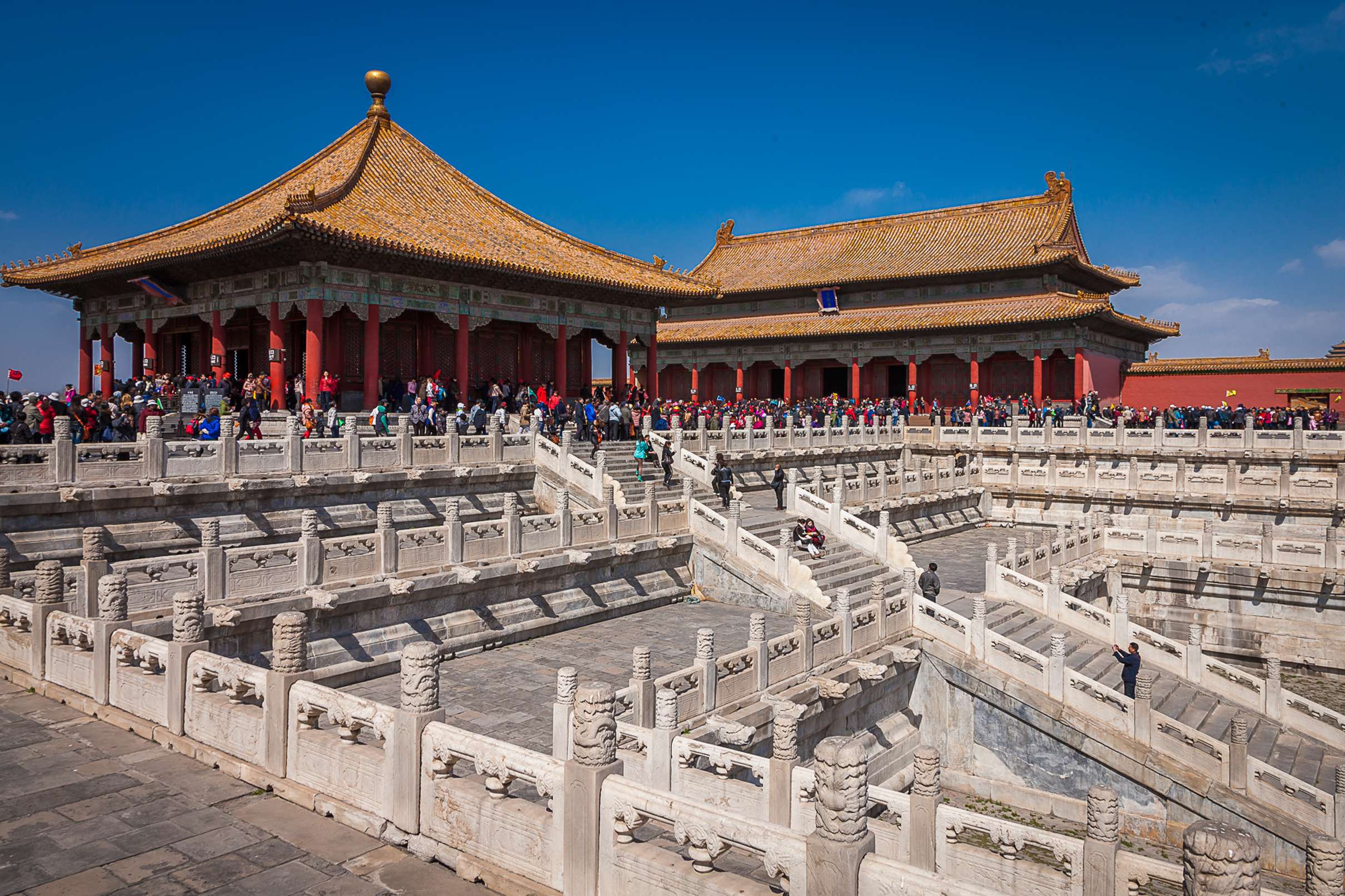
The Hall of Supreme Harmony is the building most visitors picture when they think of the Forbidden City. Its raised marble terrace, sweeping roof and vast court were designed for major ceremonies and displays of imperial power. I stood here for a long time on the first visit, and I still think it deserves that attention.
Look back across the space you have walked through, then turn towards the smaller features at the base of the terrace. The little details start to make sense once you stop trying to take in the whole building at once.


3. Halls of Central Harmony and Preserving Harmony
These come one after another behind the Hall of Supreme Harmony. They are smaller, so it is easier to notice individual details. The huge carved stone ramp at the rear of the Hall of Preserving Harmony is one of the places I lingered on the guided walk. Mei gave those elaborate dragon designs a historical context that a quick photograph could never provide.
There is no need to spend the same amount of time at all three halls. See the sequence, notice how their functions and scale change, and save some energy for the Inner Court.

4. Inner Court: the palace feels different here
Beyond the ceremonial halls you reach the residential and governing heart of the palace: the Palace of Heavenly Purity, Hall of Union and Palace of Earthly Tranquility. The spaces are still imposing, but they feel more human after the enormous courts to the south. They also changed function over centuries, which is one of the things I appreciated much more with a guide.
Look at the change in proportions. The architecture is no longer only about an emperor appearing before officials. This was also a place with households, routines, rules and a complicated private world behind the public ceremonies.

5. Leave the central axis for a side courtyard
This is the turn I missed on my first visit. Walk into one of the accessible eastern or western palace areas rather than staying with the continuous stream of people heading for the exit. The spaces are smaller: windows, doorways, roof ornaments and trees start to matter more than giant squares.
Not every courtyard or building is open every day, and restoration work can change which areas you can enter. Rather than chasing one particular palace room, explore whichever side area is open and appeals to you. The point is to see another scale of imperial life.
The contrast stayed with me. The grand halls impressed me, but it was in the side courtyards that I began to imagine people living behind those red walls.


6. Imperial Garden: slow down before the exit
The Imperial Garden is compact compared with the open courts, but it has old trees, rockeries, stone paths and decorated pavilions. By this point in the visit, I was ready for somewhere that didn’t feel quite so monumental.
Take a closer look at the pavilion ceilings. Those painted details were among the things I appreciated more on my second visit, after spending hours learning to notice the smaller choices in the architecture.


7. Leave through Shenwumen
The north gate is the natural finish. After walking through a long series of enclosed courtyards, stepping outside and looking towards Jingshan Hill feels like the end of one chapter and the start of another. If your legs allow it, don’t call it a day yet.
After the Forbidden City, Go Up Jingshan Park
From inside the Forbidden City, it is hard to understand its full layout. The walls and buildings keep hiding the next courtyard. Once you climb Jingshan Hill, all of that changes. The rooftops, the central axis and the scale of the palace spread out below you.
The climb to the viewpoint takes roughly ten to fifteen minutes depending on your pace. Jingshan is a separate park with its own entrance and admission arrangements. When you leave through Shenwumen, follow the pedestrian crossings and signs to the park rather than crossing the road wherever you like.
I think of this view as the final part of the Forbidden City visit, not just an unrelated photo stop. It also helps explain why the palace was built and arranged the way it was.


Two Hours, Four Hours or More?
Short on time: about 2 hours
Keep to the main ceremonial halls and Inner Court, then visit the Imperial Garden and leave via Shenwumen. You’ll see the essential layout, but little of the quieter residential side.
Don’t add both paid galleries if you’re already rushing.
Best balance: 3–4 hours
Follow the route above and explore at least one accessible side courtyard. This is the version that gives you both the grandeur of the Outer Court and a more personal side of the palace.
Add another half hour or so for Jingshan after leaving.
History or museum-focused: 5 hours or more
Give the side palaces more time and consider the Treasure Gallery and Gallery of Clocks. Check what is open and whether those extra tickets fit your interests.
A guide can be especially useful if you enjoy the historical context.
Visiting with limited mobility
Stick mainly to the central route and allow more breaks. Most of the large courtyards have broad paved surfaces, but the distances are considerable and some buildings have stairs or raised thresholds.
Jingshan Hill is optional; there is no need to turn the day into a test of stamina.
Practical Tips Before You Enter
- Bring the original passport. Your reservation is tied to the identification used in the booking.
- Save the entrance name in Chinese: 午门 (Wumen). A driver or map application may otherwise take you towards a different gate or a general palace location.
- Wear comfortable shoes. The scale of the courtyards means a lot of walking even without entering side palaces.
- Carry water and eat beforehand. There are visitor facilities, but stops can interrupt your route, and peak-season queues are an unnecessary diversion.
- Keep bags manageable. Avoid arriving with large suitcases on the way from the airport or railway station; check current museum restrictions and any storage arrangements.
- Allow time for security. Ticket time and the time you walk through Meridian Gate aren’t necessarily identical.
- Check temporary closures. Restoration, special events and public holidays can affect access to certain halls and routes.
For a smoother first day in Beijing, the China travel apps guide covers maps, translation and ride-hailing, while my China payment guide explains Alipay and WeChat Pay with foreign bank cards. If you need Western apps and online maps while out sightseeing, compare the options in my China eSIM guide and VPN guide for China.
Where to stay near the Forbidden City
Wangfujing and parts of Dongcheng are practical bases for the palace, but the exact hotel location matters. The entrance is on the south side, and the exit is north, so a hotel that looks close to the palace on a map may not be especially convenient for your arrival. My guide to where to stay in Beijing compares the areas and hotels with that kind of sightseeing in mind.
What else fits into the same day?
Tiananmen Square and the Forbidden City fit together geographically, but each has its own access rules. Tiananmen Square first makes sense if you want to visit both and can leave enough time for security. After the palace, Jingshan is the easiest addition.
Don’t automatically squeeze the National Museum of China into the same afternoon. It deserves attention of its own, and it’s another very large building with separate reservation requirements. I visited the Temple of Heaven after time spent at the palace on one occasion; the trees and open paths felt wonderfully different, although it made for a long sightseeing day.
For a wider plan, my five-day Beijing itinerary separates the bigger sights into realistic days, including the Summer Palace and the Great Wall at Mutianyu.
Forbidden City Beijing: Frequently Asked Questions
Do I need to buy Forbidden City tickets in advance?
Yes. The Palace Museum uses real-name advance reservations and says normal same-day ticket sales are not available. Tickets open seven days ahead at 20:00 Beijing time. Use the official English booking site or a reputable guided tour that clearly includes admission.
Can foreigners book tickets without a Chinese phone number?
The official Palace Museum website offers an English interface and email-based registration for international visitors. You can book with your passport details; check the current verification and payment steps on the booking site.
What is the best entrance for the Forbidden City?
There is only one public visitor entrance: Meridian Gate (Wumen, 午门) in the south. The northern Gate of Divine Prowess and eastern Donghuamen are exits.
Do I have to book Tiananmen Square to visit the Forbidden City?
No. The palace can be approached without adding a visit to Tiananmen Square, though security and access arrangements around the area can change. If you intend to enter Tiananmen Square itself, follow its separate booking rules.
How long does it take to walk through the Forbidden City?
About three to four hours is comfortable for the ceremonial halls, the Inner Court and at least one side courtyard. Allow longer for the Treasure and Clock galleries, and some extra time afterwards for Jingshan Park.
Is the Forbidden City open on Monday?
Normally not. The Palace Museum closes on Mondays, with exceptions for certain statutory public holidays. Check the official calendar for your exact date.
Is a Forbidden City guided tour worth it?
After visiting independently and then spending four hours with Mei, I got much more from the guided visit. The buildings became easier to understand when someone explained the ceremonies, hierarchy and private life behind the architecture. Independent travel is still a good option if you prefer complete control over your time.
Does a Forbidden City tour include Jingshan Park?
Not necessarily. Jingshan is a separate park and ticket. Some tour itineraries include it or offer it as an add-on, but check the exact inclusions before booking.
Should I add the Treasure Gallery and Gallery of Clocks?
They are good additions for anyone especially interested in imperial objects and decorative art. For a first visit with only three hours, I would focus on the main palace route and some quieter courtyards rather than trying to squeeze in both extra galleries.
Last Updated on 12/10/2026 by Panos


