
Mount Aragats makes one of the most varied day trips from Yerevan even if you have no intention of climbing to a summit. I drove this route across the southern slopes of Aragats, combining Ashtarak, Byurakan Astrophysical Observatory, the unusual Herouni radio telescope, Tegher Monastery, Amberd Fortress and Kari Lake at around 3,200 meters (10,500 ft) before returning via the Armenian Alphabet Monument.
Allow 9–12 hours for the full route in this guide. Amberd and Kari Lake are the essential stops; Ashtarak, Byurakan, ROT-54 and Tegher are the additions that turn it into a much more unusual day. If your goal is to hike to the South Summit of Mount Aragats rather than explore the region by car, I explain below how the itinerary needs to change.
I did this route by car as part of my wider Armenia road trip, so this guide focuses on the actual driving sequence, realistic timings, altitude, road conditions and which stops I would keep if you have less time.
Mount Aragats Day Trip at a Glance
This is the full Mount Aragats route I followed from Yerevan, including the main sights, realistic timing, altitude and the easiest ways to get around.
| Start/end | Yerevan |
|---|---|
| Full route | Ashtarak → Byurakan → ROT-54 → Tegher → Amberd → Kari Lake → Armenian Alphabet Monument → Yerevan |
| Time needed | 9–12 hours for my full route |
| Essential stops | Amberd Fortress and Kari Lake |
| Highest point by car | Kari Lake, around 3,200 m (10,500 ft) |
| Best season | Roughly late spring to early autumn; access to Kari Lake depends on snow and road conditions |
| Do you climb Aragats? | No. This itinerary reaches Kari Lake; summiting Mount Aragats is a separate hike |
| Best transport | Self-drive, private driver or organized tour |
| Public transport | Not practical for the complete itinerary |
This full-day option from Yerevan includes Amberd, Aragats, Saghmosavank and the Armenian Alphabet Monument.
Compare rental cars for Armenia if you prefer to follow the route independently and stop at your own pace.
Road access to Kari Lake is seasonal and can change with snow and weather, especially outside the main summer months.
The tour and rental-car links above are affiliate links. If you book through them, I may earn a commission at no extra cost to you.
Short on time? If I had only 7–8 hours, I would prioritize Amberd Fortress and Kari Lake, then add the Armenian Alphabet Monument on the way back. Ashtarak, the Herouni telescope and Tegher are the easiest stops to drop; keep Byurakan if you have booked a visit in advance and astronomy genuinely interests you.

Table of Contents
Mount Aragats Day Trip Map and Driving Route
My route runs Yerevan → Ashtarak → Byurakan → Herouni Telescope → Tegher → Amberd → Kari Lake → Armenian Alphabet Monument → Yerevan. The extra Ashtarak, Byurakan, Herouni and Tegher stops make this considerably longer than the standard Amberd–Kari Lake circuit.
Doing a longer road trip? This Mount Aragats route fits naturally into my 2-week Armenia road trip itinerary, where I continue west toward Gyumri rather than treating every destination as a separate trip from Yerevan.
Mount Aragats Day Trip vs Hiking Mount Aragats
You do not have to climb Mount Aragats to visit it. The itinerary in this guide is primarily a road trip around its southern slopes and ends at Kari Lake, around 3,200 meters (10,500 ft) above sea level.
Mount Aragats has four summits. The North Summit, at around 4,090 meters (13,419 ft), is Armenia’s highest point, while the South Summit at roughly 3,888 meters (10,756 ft) is the usual choice for day hikers starting from Kari Lake. Depending on the route, expect roughly 8–12 km (5–7.5 miles) of hiking, around 650–700 meters (2,133–2,297 ft) of elevation gain and about five hours or more on the mountain. This is a proper high-altitude hike requiring good footwear, reasonable fitness and suitable weather, not an extension I would casually tack onto the sightseeing itinerary.
My recommendation: choose one of two days:
- Sightseeing day: follow the full route in this guide.
- Summit day: drive directly toward Kari Lake, hike the South Summit, and add Amberd only if time and weather allow.

Stop 1: Ashtarak – A Charming First Taste of Armenian Heartland
Ashtarak is an easy first stop on the way out of Yerevan and gives this route a gentler start before you climb into the Aragats highlands. Just 30 minutes northwest of the capital, this small town often gets overlooked, but pausing here adds depth to the journey and offers a genuine glimpse of provincial Armenia.
I started at the Old Bridge of Ashtarak, a 17th‑century stone crossing over the Kasagh River. Its arches have carried caravans and villagers for centuries, and standing there in the morning light set a slower rhythm for the day. A short walk away is Karmravor Church, one of the tiniest yet most remarkable early Christian churches in Armenia. Built in the 7th century, it still has its original clay tile roof intact, a rare survival after more than 1,300 years.
Local legend adds color too: the town’s name, meaning “tower” or “fortress,” is tied to a tragic tale of three sisters who fell for the same man and leapt into the gorge. Whether myth or memory, it captures the drama woven into Armenia’s landscapes.
Stop 2: Byurakan Astrophysical Observatory – Stargazing in Daylight
As the road climbs into the Aragatsotn foothills, the air cools and the trees thin. Soon the silver domes of the Byurakan Astrophysical Observatory appear, a reminder of Armenia’s scientific golden age. Founded in 1946 by Victor Ambartsumian, one of the Soviet Union’s most influential astrophysicists, this site once led global research on stellar associations and quasars. Even today, “Byurakan” still surfaces in scientific journals, proof of its enduring legacy.
There is no polished visitor center or flashy signage. Instead, the grounds mix fading Soviet architecture with quiet pine‑lined paths. Walking between the domes, I felt the stillness of a place where time seems suspended. A staff member even let me peek inside an old telescope, its mechanics creaking but still functional. Standing there, I realized how many questions about the universe were first explored in these Armenian hills.
Why visit Byurakan Observatory: It adds intellectual depth to a Mount Aragats day trip from Yerevan, connecting Armenia’s landscapes with its role in global astronomy.
Stop 3: Herouni Radio-Optical Telescope (ROT-54/2.6): Armenia’s Soviet-Era Science Landmark
Leaving Byurakan behind, I followed a rough track into the hills until the enormous Herouni Radio-Optical Telescope appeared ahead of me. Also known as the Orgov telescope or ROT-54/2.6, it was designed under Armenian scientist Paris Herouni and built between 1975 and 1985. Its fixed 54-meter radio reflector is combined with a 2.6-meter (8.5 ft) optical telescope, making it one of Armenia’s most unusual pieces of Soviet-era scientific infrastructure.
When I visited, the complex still had the eerie feel of an abandoned scientific site. That has since changed. The surrounding Scientific Center of Aragats now operates formal visitor access, so use the 2026 information above rather than older blogs describing it as somewhere you can simply wander into.
Stop 4: Tegher Monastery: Quiet 13th-Century Stop Near Aragats
Tegher Monastery wasn’t even on my original list, but it ended up being one of the most memorable stops of my Mount Aragats day trip from Yerevan. Sitting quietly on the southern slopes, it doesn’t get the same attention as Amberd Fortress or Kari Lake, which is exactly why I liked it.
The approach is striking: dark basalt walls rising against golden hills, the kind of contrast that makes you stop the car just to take it in. Tegher is a 13th-century monastery built from dark grey basalt. An inscription attributes the church to Mamakhatun, wife of Vache Vachutyan, and names Aghbayrik as its architect. Inside, the dome lets in a soft shaft of light that shifts across the stone; simple, but powerful.
What stuck with me was how untouched it felt. No ticket booth, no souvenir stalls, just the sound of wind and the sense that this place has been standing here, quietly, for 800 years. A local I met later told me a story that villagers once carried the stones up in baskets to build it together. Whether that’s true or not, it fits the atmosphere: communal effort, resilience, and faith carved into the hillside.
Stop 5: Amberd Fortress and Vahramashen Church
The drive from the Herouni telescope to Amberd Fortress felt like stepping into another world. The asphalt gave way to rougher terrain, the wind grew stronger, and by the time I reached 2,300 meters, clouds were spilling over the ridges. The name Amberd, meaning “fortress in the clouds,” suddenly made perfect sense.
Perched at the meeting point of the Arkashen and Amberd rivers, this 7th‑century stronghold was later expanded in the 11th century by the Pahlavuni princes. Amberd Fortress was built to guard the northern approaches to the Ararat Plain, and its position offered both commanding views and natural defenses. Even after centuries of invasions and earthquakes, the basalt walls still stand with quiet authority. Walking through the arched gateways, I ran my hand along the rough stone and looked through the narrow arrow slits, imagining the sentries who once kept watch here.
A short walk away is Vahramashen Church, built in 1026 by Prince Vahram Pahlavuni. Its compact design and elegant proportions make it one of the most striking churches in Aragatsotn. Inside, the space is simple and solemn, still used for pilgrimages and memorial visits.


Stop 6: Kari Lake (3,200 m): The High Point of the Mount Aragats Drive
The road beyond Amberd Fortress climbs higher into the Aragats range, where meadows give way to bare rock and patches of lingering snow. By the time I reached Kari Lake, sitting at nearly 3,200 meters (10,500 ft) above sea level, the air was thin and sharp, and the sky felt close enough to touch.
For this itinerary, Kari Lake is the turnaround point rather than the start of a summit attempt. The trail toward the South Summit begins here, so this is where the sightseeing and hiking versions of a Mount Aragats day effectively split.
This high‑altitude lake near Mount Aragats is both dramatic and calm. On still days, the surface mirrors the slopes and drifting clouds with perfect clarity. When the wind picks up, the reflections break apart and the place feels raw and untamed. Kari Lake also serves as the base camp for hikers attempting Armenia’s highest peak, but even without climbing further, the lake itself is worth the journey. I walked along the rocky shore, listening to marmots whistling in the distance and the occasional cowbell echoing across the slopes.
If you are planning on continuing your hike towards the top of Mount Aragats, I recommend spending the night at a hotel in the area and dedicating day 2 to the hike itself. Then when you head back to Yerevan, you can stop at the Armenian Alphabet Monument (see next section).


Stop 7: Armenian Alphabet Monument: Final Stop Before Yerevan
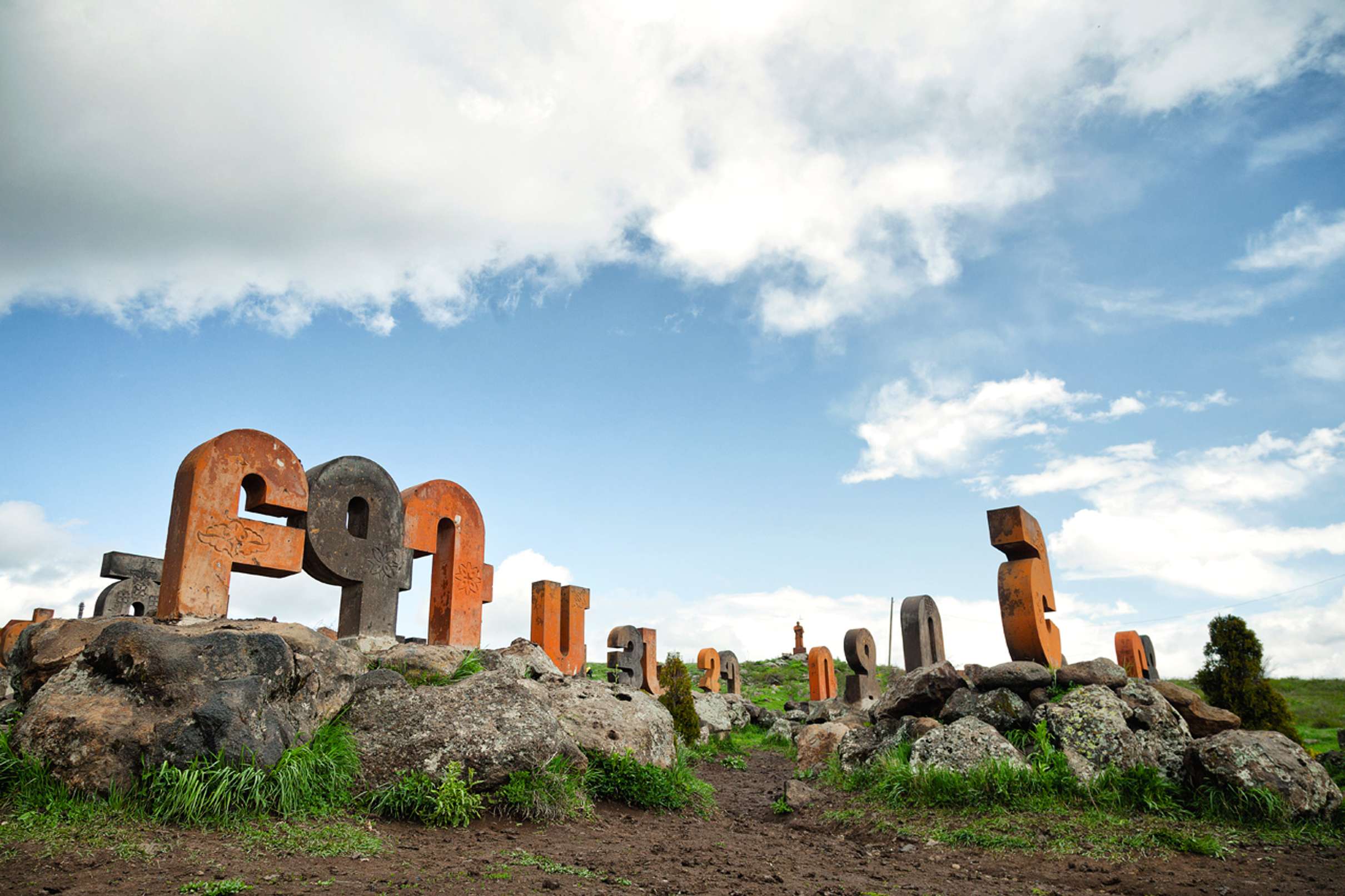
On the drive back to Yerevan from Mount Aragats, I stopped at the Armenian Alphabet Monument near the village of Artashavan. Set against the backdrop of Aragatsotn’s wide landscapes, this open‑air installation celebrates one of Armenia’s most enduring symbols: its unique script. Built in 2005 to mark the 1,600th anniversary of the alphabet, the site features 39 massive stone letters scattered across a hillside, each carved with care and presence.
The Armenian alphabet was created in the 5th century by Mesrop Mashtots to safeguard the language and strengthen cultural identity. A statue of Mashtots stands at the entrance, a reminder of how central this script remains to Armenia’s history and resilience.
I spent half an hour walking among the basalt letters, pausing to find the first character of my own name and taking in the craftsmanship. It is a photogenic spot, but what struck me most was how it connects language, landscape, and identity in one place.
Continuing west through Armenia? If Mount Aragats is part of a longer road trip rather than a day trip from Yerevan, Gyumri is the logical next major stop. My guide to the best things to do in Gyumri covers what to see and how to make the most of your time there.
Why Mount Aragats Is Worth Visiting
My Mount Aragats day trip from Yerevan turned out to be one of the most rewarding experiences I had in Armenia. It combined everything I look for in travel: authentic history, unexpected discoveries, and landscapes that shift with every turn of the road. Unlike Armenia’s more famous sites, Aragatsotn Province felt unhurried and uncrowded, which made each stop more meaningful.
In a single day I walked across a 7th‑century churchyard in Ashtarak, stood beneath Cold War‑era observatories in Byurakan, explored Amberd Fortress rising through the clouds, and ended at Kari Lake, a glacier‑fed mirror at 3,200 meters. Few places offer that kind of variety in such a compact route.
Who I would recommend this day trip to: Choose Mount Aragats if you want mountain scenery without committing to a full hike, enjoy combining history with more unusual scientific sites, and don’t mind a long day on the road. If your priority is purely medieval architecture, there are easier day trips from Yerevan; Aragats is strongest when the changing landscape and altitude are part of what you came for.
Need help planning your day trip from Yerevan? I can help!

Practical Information
Duration
- Expect this trip to take a full day, with 9-12 hours of travel and exploration, depending on how long you spend at each stop.
- If you want to hike to the top of Mount Aragats, I suggest spending a night around Lake Kari or Byurakan (see my recommended accommodations below).
Best Time to Visit Mount Aragats
For the complete route including Kari Lake, I would aim for June to September. I would not plan a May visit on the assumption that the road will be open: snow can linger much later at 3,200 meters even when conditions in Yerevan already feel like summer. Late May and October can work, but conditions vary from year to year, so check road access shortly before leaving.
For Amberd, Byurakan, Tegher and the lower Aragatsotn stops, the usable season is longer. That distinction matters: a perfectly pleasant April day in Yerevan does not necessarily mean you can drive to 3,200 meters.
How to Get from Yerevan to Mount Aragats
Self drive
I drove this route myself in an Opel Corsa. The road conditions changed as I gained altitude, but the road remained paved and was manageable with a regular car. I would download the route offline before leaving Yerevan because mobile coverage becomes less reliable around some of the detours.

Organized tour
If you don’t want to drive yourself, an organized Mount Aragats tour is the simplest option. Most standard tours focus on Amberd, Kari Lake, the Alphabet Monument and another cultural stop, rather than following every offbeat stop in my route.
Public transport
Public transport is not a practical way to replicate the full itinerary in this guide. Some lower villages can be reached independently, but connecting Ashtarak, Byurakan, Tegher, Amberd and Kari Lake in one day requires a car, driver or organized tour.
Accommodation near Mount Aragats
Yerevan is the most convenient base for a day trip to Mount Aragats, with far more accommodation and restaurant options than you will find around the mountain itself. If you are spending a few days in the capital, my Yerevan city guide covers the main sights, less obvious places and practical tips for planning your time there and my guide on where to stay in Yerevan helps you choose the base that works best for your itinerary.
If you’re considering a multi-day trip, Byurakan and nearby towns like Ashtarak have a handful of guesthouses and eco-lodges offering mountain views. This could be a quiet escape to immerse yourself in the region’s natural beauty.
Below are three accommodation options worth checking if you prefer to stay closer to the mountain.


Food
Food options on the way up Mount Aragats are limited, so bring snacks and plenty of water for the drive.
Near Kari Lake, there’s a small mountain lodge where you can warm up with simple dishes. Think hot soup, tea, maybe something sweet if you’re lucky. It’s basic but perfect after the wind and altitude. Bring cash; card machines aren’t guaranteed to work this high up.
What to Wear
Mount Aragats is all about changing weather, so dress in layers you can easily add or remove. Even in July or August, the temperature drops quickly as you climb.
Wear sturdy shoes with good grip, because the paths around Amberd Fortress and the surrounding slopes can be rocky and uneven.
If you’re visiting in spring or autumn, pack a light jacket or sweater. The wind at higher elevations can surprise you.
Prepare for High Altitude
Kari Lake sits at around 3,200 meters (10,500 ft), and you gain that altitude quickly by road. Even without hiking, some visitors may notice the thinner air. Take it easy when you arrive, avoid rushing around immediately, drink normally, and pay attention to how you feel. If you know you are sensitive to altitude or have relevant medical concerns, discuss the trip with your doctor beforehand.

Mount Aragats Day Trip FAQ
A few practical things worth knowing before following this Mount Aragats route from Yerevan.
Can you visit Mount Aragats without hiking?
Yes. This itinerary is primarily a sightseeing road trip rather than a summit hike. You can visit Amberd Fortress, Tegher Monastery, Byurakan and the other stops before driving up to Kari Lake at around 3,200 meters without climbing one of Mount Aragats’ summits.
Can you drive to Kari Lake?
Yes, when the high mountain road is open. Kari Lake can be reached by road, but access is seasonal and depends on snow, weather and current road conditions. Check conditions locally before setting out, particularly in late spring or autumn.
Do I need a 4WD to drive to Kari Lake?
I didn’t. I drove the full route to Kari Lake in an Opel Corsa, and during my visit the road remained paved and manageable with a regular car. Based on my experience, a 4WD was not necessary under normal summer conditions. Mountain roads can deteriorate, however, and snow, heavy rain or roadworks can change conditions quickly, so check locally before leaving Yerevan if the weather has been poor or you are traveling outside summer.
How long does this Mount Aragats day trip take?
Allow around 9–12 hours for the complete route described in this guide, including Ashtarak, Byurakan, ROT-54, Tegher, Amberd Fortress, Kari Lake and the Armenian Alphabet Monument. If you only visit Amberd and Kari Lake, the trip can be considerably shorter.
Does this itinerary include climbing Mount Aragats?
No. The route reaches Kari Lake, which is a common starting point for summit hikes, but climbing Mount Aragats is a separate activity. If reaching a summit is your priority, I would dedicate the day mainly to the hike rather than trying to combine it with every stop in this itinerary.
Can you visit Mount Aragats without a car?
Yes, but realistically you will need an organized tour or private driver. Public transport can get you to some of the lower settlements, but it is not a practical way to combine Amberd, Kari Lake and the other stops in this itinerary in a single day.
What is the best season for Kari Lake and Amberd?
The most reliable period for the complete high-altitude route is generally from late spring through early autumn, with summer giving you the best chance of clear road access to Kari Lake. Conditions at 3,200 meters can be very different from the weather in Yerevan, so check the mountain road before leaving.
Last Updated on 08/08/2026 by Panos


