

Kythnos Travel Guide: Beaches, Villages, Hot Springs & a Realistic 4-Day Route
Kythnos is one of the easiest Cycladic islands to reach from Athens, but it does not feel like an island designed around weekend tourism. Drive ten minutes away from Merichas and the roads narrow, villages move inland, beaches disappear behind dirt tracks and the whole place becomes much quieter.
I stayed in both Merichas and Chora and explored Kythnos by rental car, which gave me two very different versions of the island. Merichas was practical and made beach days easy. Chora was where I wanted to be once the sun disappeared and tables began filling the alleys.
What surprised me most was how badly Kythnos fits the usual “small island, easy to see quickly” logic. The distances are short. The roads are not always. Kolona is close to Merichas on a map but has an awkward final approach. Southern beaches can absorb most of a day. Dryopida and Chora are close geographically but feel completely different.
So this guide is organized around how Kythnos really works on the ground: the roads, the village combinations, which beaches are worth the effort, when a boat makes more sense than a car, and how to leave enough time for food, hiking and an actual evening in the villages.
Updated October 2026.
How long should you spend in Kythnos?
Three to four nights is ideal for a first trip. A weekend works, but you will have to choose between beach time and the inland villages. With four days you can see Kolona, Loutra, Chora, Dryopida and Kanala without spending the whole trip in the car.
My Kythnos map: beaches, villages, roads and hiking routes
Kythnos is only about 100 km², but beach access makes the island feel larger. The main paved spine is simple; the interesting complications begin when you leave it.
Think of Kythnos as four different day-trip corridors
This works much better than jumping between isolated “must-sees.”
The easiest beach-hopping corridor until the road becomes rough near Kolona.
The village day: whitewashed Chora, tiled Dryopida, food and the cave.
Thermal water, marina life and quieter northern coves.
Longer drives, pilgrimage churches and the beaches where Kythnos feels emptiest.

Kolona is worth seeing — but choose how you get there
The sandbar is spectacular. The final drive is less glamorous.
Kolona is the image most people already know before they reach Kythnos: a narrow strip of sand connecting the main island with Agios Loukas, with sea on both sides.
It deserves the attention. What travel photos do not show is that the final road is rough, parking is limited and the beach itself has very little natural shade.

I have done Kolona both ways: by car over the dirt road and by water taxi from Merichas. Unless driving rough tracks is part of the fun for you, the boat is the far more relaxing approach.
You arrive looking at the sandbar from the water instead of spending the last part of the journey concentrating on potholes.
Seasonal boats leave from Merichas for Kolona and nearby Apokrousi, particularly in summer. Sea conditions matter, so ask at the port the day before rather than assuming every departure runs regardless of wind.
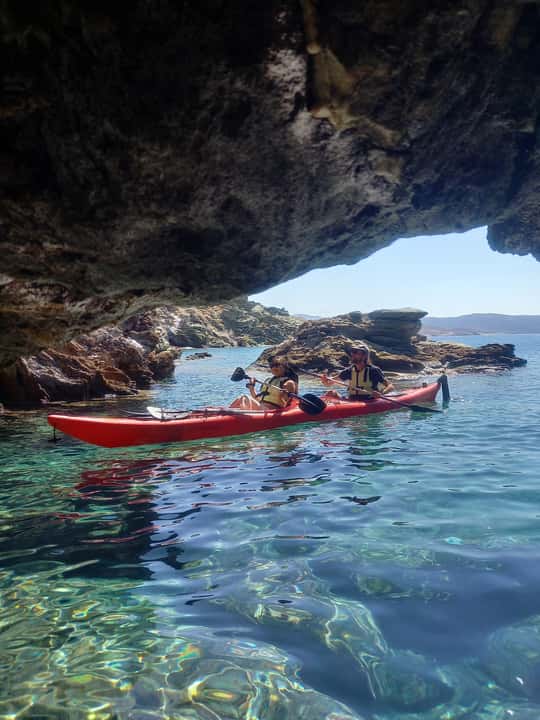
Guided Kayak Tour, Hot Springs & Local Delicacies
A more active way to experience Kolona and the western coast, combining paddling, swimming, thermal water and local food.
Check Kayak TourChora and Dryopida show two completely different Kythnos
I would deliberately see both rather than treating one as a substitute for the other.
Chora (Messaria)
Chora sits along a ridge rather than above a port, so there is no obvious seafront or single postcard viewpoint. Its appeal is in the alleys, small squares, cafés, churches and ordinary evening life.
Staying here changed my impression of Kythnos. During the day Chora can feel sleepy. After sunset, tables appear outside, children run through the lanes and the center fills without ever turning into a nightlife destination.

Dryopida
Dryopida could almost belong to a different island. Red-tiled roofs replace much of the classic all-white Cycladic look, while the village folds into a valley hidden from the sea.
It has a long pottery tradition and several small museums, but what I remember most is arriving late in the afternoon and seeing residents begin placing chairs outside their homes.
Come before sunset, walk the upper and lower lanes, then eat here rather than treating the village as a quick stop before Katafyki Cave.


Katafyki Cave
Katafyki combines a natural cave with former mining galleries directly beneath the edge of Dryopida. Over the centuries it served as a refuge, storage space, mine and gathering place.
It is one of the more unusual sights on an island otherwise dominated by open sky and exposed hills.
Access is supervised and opening arrangements can vary through the season, so check the current visiting times in Dryopida before planning the whole afternoon around entry.
Loutra’s hot springs are genuinely unusual for the Cyclades
The thermal water reaches the shoreline beside an ordinary little marina village.
Loutra sits on the northeast coast and grew around thermal springs that gave Kythnos its older name, Thermia.
There are two main thermal sources. The historic Agioi Anargyroi spring is associated with the old hydrotherapy complex, while the nearby Kakavos source emerges at temperatures reaching about 52°C (126°F) before the water makes its way toward the coast.
The easiest experience is the natural outflow beside the beach, where the hot water mixes with the Aegean.
I went after a long day of driving. Moving between the warm thermal water and the cooler sea a few steps away was one of the most memorable small experiences of the trip.
Loutra itself is also useful as a base: marina, cafés, restaurants and easy swimming without needing the car for every meal.
Maroulas, Vryokastro and the lost medieval capital
Kythnos has archaeological depth that most quick weekend itineraries barely touch.
The prehistoric settlement at Maroulas dates to around the ninth millennium BC, placing human activity on Kythnos extraordinarily early in the Aegean story.
Later, ancient Kythnos centered on Vryokastro, where remains of sanctuaries, fortifications and settlement occupy the western hills above the sea.
Much later, during the medieval period, the population moved to the fortified Castle of Oria, dramatically positioned on a northern headland before Chora and Dryopida became the main inland settlements.

Oria Castle
The ruins are scattered rather than monumental, but the setting explains why the site mattered. Cliffs protect the headland and the view opens across a huge sweep of the northern Aegean.
Hiking in Kythnos
Walking connects beaches, chapels, terraces and archaeological sites in a way the main road never does.
| Route | Distance | Time | Why do it |
|---|---|---|---|
| Kolona → Agios Loukas | 2.6 km (1.6 mi) | 30–60 min | Short climb with the classic view back over the sandbar |
| Lefkes → windmills → Dryopida | 7.6 km (4.7 mi) | 2.5–3 hr | Old paths, windmills and the village |
| Megali Ammos → Skylou | 7.1 km (4.4 mi) | 2.5–3 hr | A quieter coastal route between beaches |
| Kanala → Kato Livadi → Lefkes | 8.2 km (5.1 mi) | 2.5–3 hr | Pilgrimage site, valley and coast |
| Episkopi → Apokrousi → Kolona → Agios Loukas | 10.3 km (6.4 mi) | 3–3.5 hr | Vryokastro, beaches and the iconic Kolona viewpoint |
| Agios Ioannis Beach → chapel | 11.3 km (7 mi) | 4–4.5 hr | Remote coast, elevation and solitude |
| Lefkes → Dryopida → Agios Ioannis Eleimonas | 14.6 km (9.1 mi) | 4.5–5 hr | The longer countryside route through central Kythnos |
The climb above Kolona toward Agios Loukas was the route I enjoyed most. It is short enough not to take over the day, and from above the entire double sandbar suddenly makes geographic sense.

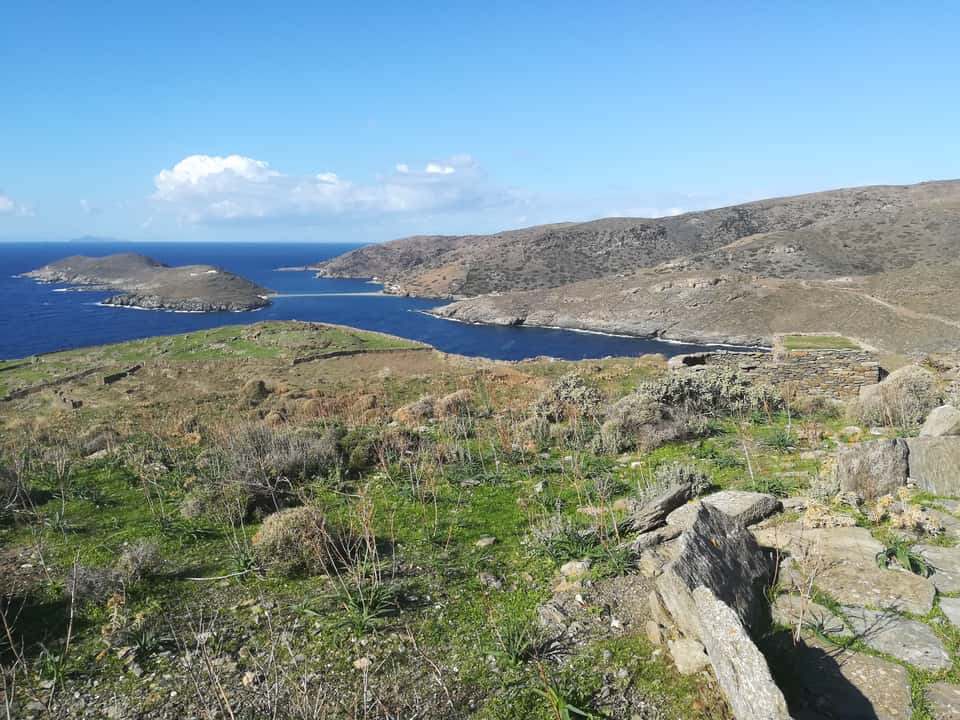
Kythnos Ancient Trail Hiking Tour
Walk one of the island’s old routes with local context on the landscape, history and settlements rather than navigating the paths alone.
Check Hiking TourChurches, pilgrimage and Kythnos panigyria
Nearly 130 chapels and churches are scattered around the island, and several still anchor major community celebrations.
Panagia Kanala
Panagia Kanala stands above the southeastern coast among pine trees, an unusual patch of green on otherwise dry Kythnos.
The church houses a revered icon of the Virgin and becomes one of the main centers of island life around the August 15 feast.

Agios Ioannis Eleimonas
Agios Ioannis Eleimonas sits on a narrow rocky peninsula on the east coast, almost surrounded by water. It is one of those places where the chapel and the geography are inseparable.

Agios Minas, Agia Triada, Agios Stefanos and Agios Sostis
- Agios Minas in Dryopida: particularly notable for its carved wooden iconostasis and throne.
- Agia Triada in Chora: the main cathedral and a focal point of village religious life.
- Agios Stefanos: right beside the sea and one of the most photogenic small chapels on the island.
- Agios Sostis: another coastal chapel where the simple setting is the main attraction.
- Panagia Flampouriani: on the rocky headland splitting Flampouria beach, with a traditional feast around August 23.

What a panigyri feels like
A village feast is not a staged cultural show. It is a religious celebration that turns into a communal evening of food, music and dancing, often continuing much later than visitors expect.
If your dates line up with one, go respectfully and let the village set the pace.
Best beaches in Kythnos compared
The municipality currently counts 99 beaches. Most travelers only need to understand about eight of them.
Agios Sostis
Agios Sostis is one of the beaches I would choose when the goal is simply space. There is very little infrastructure and the chapel above the shore gives the cove a distinctly local feel.

Agios Stefanos
Agios Stefanos is a small cove with a chapel almost at the water’s edge. The final road is narrow and there is little parking, which helps keep the beach quieter than the easier-access west coast.

Episkopi
Episkopi is one of the easiest beaches near Merichas: sandy, shallow and shaded in places by tamarisks.
This is one reason Kythnos also works well for families who do not want every beach day to involve a hike or rough road. I compare it with other options in my quiet Greek islands for families guide.

Honey, thyme and the dry Cycladic landscape
Kythnos produces fragrant thyme honey from the low aromatic vegetation that covers its hills.
Honey appears everywhere from breakfast to cheese plates and pasteli. A beekeeping visit adds something the beach-and-village circuit cannot: it explains how food production fits the island’s dry terrain.
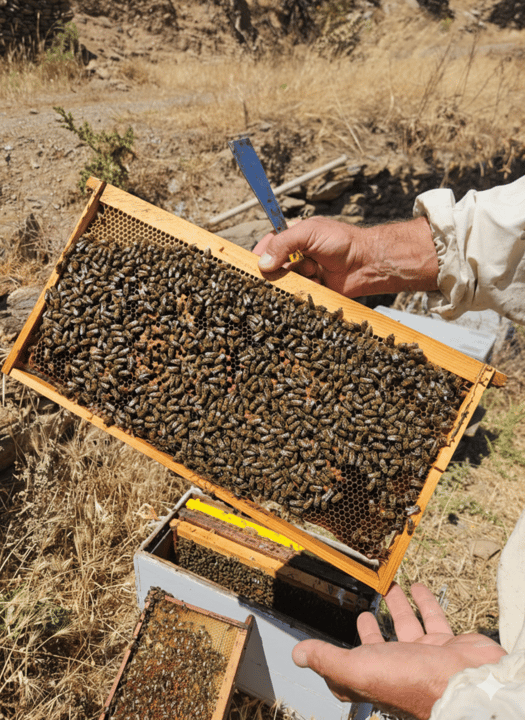
Beekeeping Experience & Honey Tasting
Meet a local beekeeper, learn how the hives work in Kythnos’ dry landscape and taste the island’s honey.
Check ExperienceWhat to eat in Kythnos
Some of the most interesting Kythnian dishes come from the inland villages and old household cooking rather than the beach tavernas.
- Revithada: chickpeas slowly cooked for hours, traditionally a Sunday dish.
- Gouna: sun-dried mackerel grilled until smoky and salty.
- Thermia pie: savory island pie with greens, cheese or meat.
- Sfougato: small fried cheese balls, ideal as part of a table of meze.
- Kopanisti: strong, peppery spreadable Cycladic cheese.
- Manoura: Kythnian cheese aged in wine sediment, giving the rind its distinctive color and tang.
- Kolopia: herb and spinach pies baked in large trays.
- Pasteli: sesame and honey sweet traditionally associated with weddings and celebrations.
- Local sausages: pork seasoned with herbs and grilled simply.
- Stuffed squid: usually filled with rice or herbs and baked or grilled.
- Strapatsada: eggs scrambled with tomato and often summer vegetables.
- Wedding meat: slow-roasted lamb or goat with potatoes for feast days and celebrations.
- Wild capers: one of the little flavors that immediately makes an ordinary salad feel Cycladic.
- Astakomakaronada: lobster pasta for a summer splurge rather than an everyday island meal.
One of the meals I remember most was just gouna and revithada in Dryopida. Nothing elaborate, nothing designed for photographs, just two dishes that tasted completely at home on the island.
Restaurants in Kythnos
Agios Dimitrios
- Milas Restaurant: traditional seaside taverna directly on Agios Dimitrios beach, useful for fresh fish and home-style Cycladic dishes when you are exploring the south.
Agios Stefanos
- Arodou Seafood Taverna: right by the bay, with daily fish, grilled octopus and exactly the sort of view that makes a long lunch more sensible than another beach drive.
Dryopida
- Mamas Kythnos: a family-run place in the village alleys for revithada, Thermia pies and the kind of cooking that makes sense after walking Dryopida.
Episkopi
- Pountaki: beach bar and restaurant on Episkopi with cocktails, Mediterranean plates, sunbeds and a livelier summer atmosphere later in the day.
Kanala
- Archipelagos: one of the places I would actively build the Kanala day around. Farm-to-table Cycladic cooking, local vegetables and wine with views over the bay.
- I Megali Ammos: easy beachfront taverna for fish and meze when you want to combine Panagia Kanala with a proper beach lunch.
- Ofiousa Restaurant: more creative presentation, sea views and a slightly bohemian café-gallery atmosphere.

Loutra
- Amélie Kythnos: polished bistro by the marina for contemporary Mediterranean food, brunch and cocktails.
- A Picco Kythnos: terrace drinks and lighter food, particularly good around sunset.
- Koutsikos: meat-focused taverna with generous portions, a useful change after several days of fish.
- MamaDo The Food Bar: burgers, bao, cocktails and a much more playful modern menu than the traditional tavernas around the island.
Merichas
- Arapis Restaurant: Italian-Greek menu with handmade pasta, pizza and wine from the family’s vineyard.
- Byzantio – Gialos Restaurant: long-standing waterfront choice for Greek seafood, meze and ouzo with the harbor directly in front of you.
- Kantouni Taverna: a grill house with better meats, an open kitchen and a more modern take on the traditional taverna.
- Mirra: creative Mediterranean dishes, brunch and burgers in a more contemporary seaside setting.
Chora
- Giagia Koukou: small, welcoming and particularly good when what you want is homemade pies and meze in the village rather than another drive to the coast.
A realistic 4-day Kythnos itinerary
This is much more satisfying than trying to touch five beaches every day.
Get oriented around the west coast. Swim at Episkopi or Apokrousi, then reach Kolona by water taxi if services are running.
Spend the evening in Chora rather than returning immediately to the port.
Give Loutra enough time for the thermal water and marina, then use the afternoon for one northern cove.
Return to Chora or stay for dinner in Loutra.
Walk Dryopida slowly rather than rushing to the cave. Continue south to Panagia Kanala and one of the surrounding beaches.
Make lunch part of the day rather than a gap between stops.
Walk one of the old trails, drive toward Gaidouromantra or Skylou, or simply return to the part of Kythnos you enjoyed most.
Four days is enough that the final day does not need another checklist.
Use Day 1 for Kolona and Chora, then Day 2 for Loutra and either Dryopida or one easy beach. Trying to add Kanala and the remote south as well turns a relaxing island into a driving exercise.
Add a serious hike, a full southern-beach day, Oria Castle and a boat or diving day. The advantage of a week is not seeing every beach; it is being able to change the plan without losing anything.
How to get to Kythnos
There is no airport. All normal arrivals are by ferry into Merichas.
Lavrio is the main reason Kythnos works so well for a shorter trip. Current municipal information gives crossings from roughly 1 hour by high-speed ferry and around 1.5 hours by conventional ferry.
Piraeus also serves Kythnos, with the fastest boats around 1.5 hours and conventional crossings closer to 2 hours 40 minutes, depending on the actual sailing.
For the detailed comparison of Lavrio versus Piraeus, airport transfers, ferry prices and bringing a car, use my Athens to Kythnos ferry guide.

Getting around Kythnos: car, buses and water taxis
Public transport covers the main settlements. It does not replace a car if remote beaches are the priority.
Rental car
I found a car extremely useful. Chora, Dryopida, Loutra and Kanala are easy enough to connect, but many beaches sit away from the bus routes.
Several beach roads are unpaved. Ask specifically whether your rental agreement covers the road you intend to drive before heading toward Kolona, Skylou or Gaidouromantra.
- Nikitos Car Rental – Chora
- Nikitos Car Rental – Merichas
- Delta Premium Drive Kythnos – Merichas
- Gonidis Cars – Merichas

Kythnos buses
Two main bus corridors connect Merichas with the principal villages:
- Merichas → Chora → Loutra
- Merichas → Dryopida → Kanala
Summer 2026 departure times from Merichas
Merichas → Chora → Loutra
08:30 to Chora only · 11:00 · 14:30 · 17:30 · 20:00
Route contact: (+30) 22810 32250
Merichas → Dryopida → Kanala
10:45 · 13:30 · 17:30
Route contacts: (+30) 22810 32005 / (+30) 6977 900 682
These are the summer 2026 departures currently listed for the two main routes. Kythnos schedules change with the season, so photograph the latest timetable at Merichas port and reconfirm before relying on a bus for your ferry connection.
Water taxis from Merichas
Seasonal boats from Merichas serve Kolona and Apokrousi. For Kolona in particular, this is not merely a sightseeing extra. It is a genuinely practical alternative to the rough approach road.
Frequency is highest in July and August and depends on sea conditions.
Where to stay in Kythnos
Your evenings change much more than your driving times.
- Merichas: easiest for ferries, car pickup, Kolona boats and quick west-coast beach days.
- Chora: my preferred choice for village evenings, restaurants and atmosphere.
- Loutra: useful if the thermal springs, marina and northern beaches are your priority.
- Dryopida: quieter inland stay with a very local feel.
- Kanala: best when you want a peaceful southeastern base close to beaches and Panagia Kanala.
I compare the practical differences and hotels in my where to stay in Kythnos guide.

When to visit and what to budget
September was my favorite balance of warm water and much calmer beaches.
April to early June is best for hiking, greener hills and quiet roads, although the sea can still feel cool.
Mid-June through August gives you the fullest ferry and restaurant schedules. August weekends can feel surprisingly busy because Kythnos is so easy for Athenians to reach.
September to mid-October is my favorite window: the sea remains warm, beaches calm down and the villages still have enough life.
Winter is genuinely quiet. Come for walking and solitude, not a full summer-island experience.
Around €60–80 per person can work with simple accommodation and taverna meals. A more typical mid-range trip with a nicer room, rental car and regular dining out is closer to €100–150 per person per day. Add more if you want private sailing, diving or more expensive seafood meals.
Mobile data, safety and practical basics
Kythnos is straightforward to travel, but the quieter beaches are exactly where offline maps become useful.
Mobile coverage is generally good around Merichas, Chora, Dryopida, Loutra and the main roads, with weaker patches around remote beaches.
For Greece-wide network testing, see my Greece eSIM guide. If you are continuing through the island group, the Cyclades eSIM guide is more useful for ferry routes and smaller-island coverage.

Nomad Greece eSIM
Set up your data before the ferry so maps, accommodation messages and car-rental details work as soon as you arrive in Merichas.
Check Greece eSIM PlansKythnos is generally very safe. The more realistic risks are narrow roads, poor lighting after dark, strong sun on hikes and heading to an isolated beach without enough water.
Pharmacies are available in the main settlements and Kythnos has a health center for basic care. More serious cases may require transfer to the mainland.

Where to go after Kythnos
Kea, Kythnos, Serifos and Sifnos make much more geographic sense together than jumping across the Cyclades.
Serifos
Serifos is the most natural next island if you want the landscape to become rougher. It has a far more dramatic hilltop Chora, mining history and a starker visual character.

Sifnos
Sifnos feels more polished than Kythnos and has a much stronger reputation for food, pottery and maintained hiking paths. The two work extremely well back to back because they are similar enough geographically but very different in style.
Kea
Kea takes you north toward Lavrio and changes the landscape again, with oak country, ancient walking paths and stone-built Ioulida.
This is also why Kythnos features prominently in my best islands near Athens guide, my best-value Greek islands comparison and my quiet Cyclades islands guide.
For a longer route, use my Greek island-hopping routes guide.
Kythnos travel guide FAQ
The questions that matter most when deciding whether the island fits your trip.
Is Kythnos worth visiting?
Yes, especially if you want beaches, traditional villages and straightforward access from Athens without the tourism intensity of the better-known Cyclades islands.
How many days do you need in Kythnos?
Three to four nights is ideal for a first visit. Two nights works for Kolona, Chora and Loutra, while a week gives you time for hiking and the remote southern beaches.
Do you need a car in Kythnos?
Not for a simple trip between Merichas, Chora, Dryopida, Loutra and Kanala. A car becomes much more useful if you want the remote beaches or several hiking routes.
How do you reach Kolona Beach?
You can drive over a rough dirt road or use a seasonal boat from Merichas. I have done both and much prefer arriving by boat.
Does Kythnos have hot springs?
Yes. Loutra has two thermal sources, and hot water reaches the shoreline beside the village where it mixes with the sea.
What are the best villages in Kythnos?
Chora and Dryopida are the two essential inland villages. Chora is whitewashed and livelier in the evening, while Dryopida has tiled roofs, pottery history and Katafyki Cave.
What are the best beaches in Kythnos?
Kolona is the most distinctive, Episkopi is one of the easiest for families, Apokrousi is broad and accessible, while Gaidouromantra and Skylou suit travelers who want more remote coves.
Does Kythnos have buses?
Yes. The two main routes connect Merichas with Chora and Loutra, and Merichas with Dryopida and Kanala. Service is limited and seasonal, so check the current timetable at the port.
Is Kythnos good for hiking?
Very. Old paths connect villages, archaeological sites, chapels and beaches. Spring and autumn are more comfortable than the hottest summer months.
Where should you stay in Kythnos?
Merichas is best for convenience and ferry logistics, while Chora is my preference for evenings. Loutra, Dryopida and Kanala suit more specific types of stay.
What is the best time to visit Kythnos?
June and September give the strongest balance of swimming weather, open restaurants, easier accommodation prices and fewer peak-season crowds.
Which islands combine naturally with Kythnos?
Kea, Serifos and Sifnos form the most logical western Cyclades chain, with Lavrio providing the mainland connection.
Kythnos is easy to reach without feeling particularly easy
For me, that is a large part of its appeal. You can get here from Lavrio faster than you can reach plenty of mainland destinations from Athens, but once the ferry leaves Merichas behind, Kythnos still asks you to work a little for its best places.
Kolona has an awkward road. Dryopida hides in the hills. The southern beaches require commitment. The old footpaths make more sense than some of the modern roads.
And then the island gives you very simple rewards: warm water in Loutra, chairs appearing outside houses in Dryopida, chickpeas and gouna on a village table, or a late evening wandering Chora without really deciding where to go next. That is the Kythnos I would plan for.
Start with three or four nights. Give each part of the island its own day. Take the boat to Kolona if it is running. Leave one lunch deliberately long.
For the ferry logistics, continue with my Athens to Kythnos guide. For choosing between Chora, Merichas, Loutra and the other bases, use my where to stay in Kythnos guide.
Last Updated on 02/10/2026 by Panos


