

Garni and Geghard were the first proper day trip I made from Yerevan during my Armenia road trip, and they remain one of the easiest routes I would recommend to a first-time visitor. I drove the route myself, combining Garni Temple, Geghard Monastery and the Symphony of Stones in one day.
What makes this day trip work so well is the contrast. In less than an hour from Yerevan, you move from Armenia’s best-known pre-Christian monument to a medieval monastery partly carved into the rock, with the basalt cliffs of Garni Gorge adding a completely different natural stop.
In this guide, I cover my tested Garni and Geghard day trip from Yerevan, including realistic driving times, how long to spend at each stop, transport options, current practical information, where I stopped for food, and whether I think you need a full day.
Garni & Geghard Day Trip Summary
- Best for
- First-time visitors, history, and scenery
- Distance from Yerevan
- About 30 km to Garni
- Drive to Garni
- About 40 minutes
- Garni to Geghard
- About 15–20 minutes
- Allow
- 5–7 hours; longer with a relaxed lunch or lavash experience
- Best way to visit
- Self-drive, private driver, or organized tour
- My route
- Yerevan → Garni → Geghard → lunch → Symphony of Stones → Yerevan
- Garni ticket
- 1,500 AMD
- Garni opening hours
- Tuesday–Sunday, 10:00–21:30
- Geghard
- Free entry
- My verdict
- Very easy to recommend for a first Armenia trip
Checked August 2026: Garni ticket prices and opening hours can change, so verify the latest information before your visit.
Table of Contents
My Garni & Geghard Day Trip Route
I drove this route as Day 2 of my Armenia road trip. My actual order was Yerevan → Garni Temple → Geghard Monastery → lunch near Garni → Symphony of Stones → Yerevan.
That worked perfectly well, but it does involve some backtracking because the Symphony of Stones is in Garni Gorge. If I were planning the day purely for efficiency now, I would visit Garni Temple and the Symphony of Stones together before continuing to Geghard, or head to Geghard first and cover both Garni stops on the way back toward Yerevan.
You can comfortably do the main sights in around 5–7 hours. If you add a long lunch, lavash-making demonstration or spend more time walking in Garni Gorge, make it a full day rather than rushing.
| Stop | Allow |
|---|---|
| Drive Yerevan → Garni | ~40 min |
| Garni Temple | 45–60 min |
| Symphony of Stones | 30–60 min |
| Garni → Geghard | ~15–20 min |
| Geghard Monastery | 60–90 min |
| Lunch | 60–90 min |
| Return to Yerevan | ~40–50 min |
Optional Stop: Charents Arch
If Mount Ararat is clear, Charents Arch is an easy additional stop on the road between Yerevan and Garni. I would treat it as an optional 10–20 minute viewpoint rather than another essential sight. It works best as a quick photo stop on the way out of Yerevan or on the return journey, especially if visibility is good enough to see Mount Ararat.

How to Get to Garni & Geghard from Yerevan
There are four realistic ways to visit Garni and Geghard from Yerevan: rental car, private driver or taxi, public transport, or an organized tour. I drove the route myself, which is the option I would choose again because it gave me complete control over the order and timing of the day.
By Rental Car — What I Did
I explored Garni and Geghard as part of my Armenia road trip, and having my own car worked particularly well here. We could leave Yerevan when we wanted, spend longer at the places we liked, stop for lunch without watching the clock, and continue down into Garni Gorge for the Symphony of Stones.
The drive from central Yerevan to Garni took us just under 40 minutes. Once outside the city, the road is straightforward and mostly well paved, passing villages and increasingly open countryside as you approach the Azat Valley. From Garni, Geghard is only another 15–20 minutes by car.
I booked my rental car through Discover Cars, where I found a good rate after comparing several rental companies. If Garni and Geghard are part of a longer Armenia road trip rather than your only excursion from Yerevan, renting a car makes considerably more sense because you can use it for places such as Mount Aragats, Lake Sevan, Dilijan, and the rest of the country as well.

For this particular route, I found self-driving easy. The bigger advantage, though, was flexibility rather than simply getting from A to B. Garni, Geghard and the Symphony of Stones are close together, so having a car lets you turn them into your own day rather than following somebody else’s timetable.
By Taxi or Private Driver
If you do not want to drive, hiring a private driver is probably the easiest alternative. The distances are short enough that you do not need a complicated multi-day transfer, and a driver can wait while you visit Garni and Geghard before taking you to the Symphony of Stones or back to Yerevan.
I would arrange the entire route and price in advance rather than taking separate one-way taxis. Garni itself is easy to reach, but finding a convenient return ride from the more rural stops can be less predictable.
Make sure the agreed route is clear before leaving Yerevan. If you want to visit Garni Temple, Geghard Monastery and the Symphony of Stones, say so explicitly and confirm whether waiting time is included. This gives you most of the flexibility of a rental car without having to drive yourself.
By Public Transport
Public transport is possible, but it is the least convenient option if you want to reproduce the full route in this guide.
Bus 266 currently connects Yerevan with Garni, departing from the Nor Nork/Gai Bus Station area. It is useful if your priority is reaching Garni cheaply, but I would verify the current departure point and return schedule locally before travelling, as Armenian regional transport information can change.
The bigger problem is Geghard. The monastery sits farther along the valley and is much less convenient to reach using regular public transport. In practice, you may need to combine the bus with a taxi for the Garni–Geghard section.
It can therefore work well for budget travelers with plenty of time, but if you want to visit Garni, Geghard and the Symphony of Stones comfortably in the same day, I think a car, driver, or tour is worth the extra cost.
By Organized Tour
An organized tour is the simplest option if you want somebody else to handle the driving and timing. For this route, I would choose a tour that stays focused on Garni, Geghard and the Symphony of Stones rather than squeezing in too many unrelated stops.
This Garni, Geghard, Symphony of Stones & Lavash Baking tour is a much closer match to the route in this guide. It currently lasts around six hours and includes transport from Yerevan, Charents Arch, Garni Temple, the Symphony of Stones, Geghard Monastery, and a traditional lavash-baking experience. It is particularly useful if you do not want to rent a car but still want to see the three main stops without piecing together buses and taxis.
Keep in mind that the Garni Temple and Symphony of Stones entrance fees are currently charged separately, so check the latest inclusions before booking.
Garni Temple: Armenia’s Greco-Roman Marvel
Practical Tips for Visiting Garni Temple
- Opening hours: Tuesday–Sunday, 10:00–21:30
- Entrance fee: 1,500 AMD for adults, 750 AMD for students and pensioners, and free for children up to the age of 12
- Facilities: Public toilets near the entrance, plus a small café and souvenir stalls on-site
- Time needed: Around 45–60 minutes to explore the temple, plus extra time if you walk down into the gorge
- Best time to visit: Early morning or late afternoon for softer light and fewer crowds
Paganism in the Caucasus
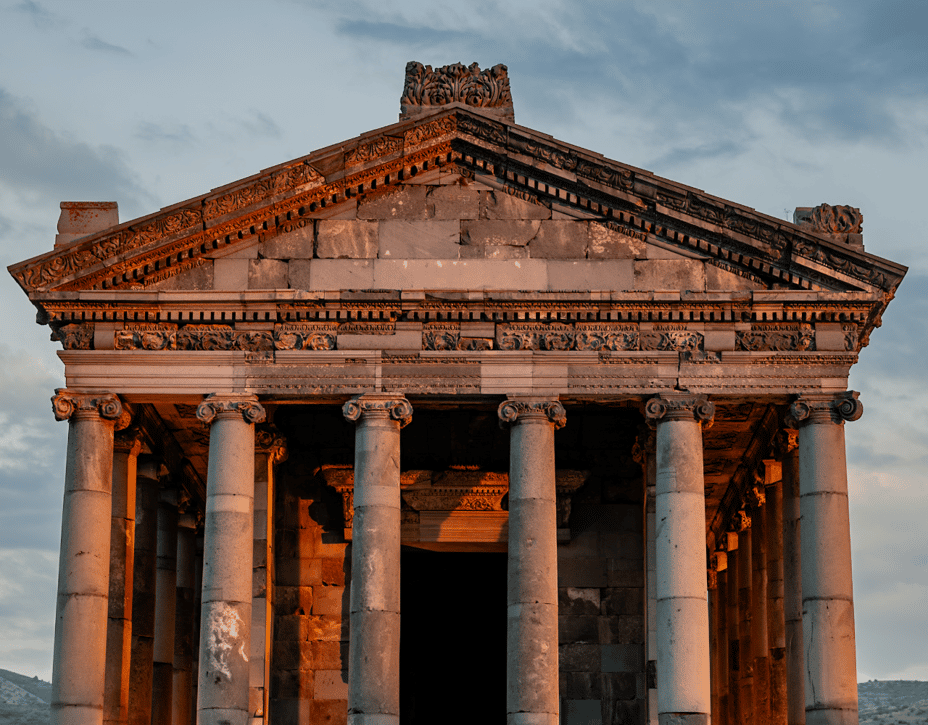
After winding up the mountain roads from Yerevan, my first glimpse of Garni Temple caught me off guard. Set dramatically on a cliff’s edge above the Azat River Gorge, this elegant structure with its symmetrical colonnade and classical silhouette feels like an illusion: a fragment of ancient Greece tucked deep into the Caucasus.
Built in the 1st century AD during the reign of King Tiridates I, the temple was dedicated to Mihr, the Zoroastrian god of the sun. At the time, Armenia was a client state of the Roman Empire, and Garni’s Hellenistic style, complete with 24 Ionic columns and pristine geometric proportions, reflected the king’s admiration for Greco-Roman ideals. It was more than a temple; it served as part of a royal summer residence, a place of ritual, rest, and regal retreat.

Why Garni Is So Unusual in Armenia
Garni is the only surviving Greco-Roman-style colonnaded building in Armenia and the former Soviet Union, which is why it looks so unlike almost every other major monument you will see on this trip.
After Armenia adopted Christianity in the early 4th century, Garni continued to be used as part of a royal complex. The structure standing today is largely the result of its Soviet-era reconstruction after the original building collapsed in the 1679 earthquake.
What you see today isn’t the untouched original. A devastating earthquake in 1679 reduced the temple to rubble. The version that stands now is the result of a painstaking Soviet-era reconstruction, carried out between 1969 and 1975, and widely praised for its architectural accuracy. It was one of the earliest projects of its kind in the USSR, a rare example of archaeological revivalism done right.
A Walk Through Ancient Symmetry
As I stepped onto the temple platform, I was struck by its perfect symmetry. The mathematical harmony of the structure, the precise spacing of the columns, the carved friezes, and the visual rhythm stood in sharp contrast to the rugged terrain that surrounds it. It felt refined and foreign, yet somehow anchored in the basalt cliffs as though it belonged there all along.
Tucked beneath the temple is a quirky little gem: a Roman-style bathhouse with a partially preserved mosaic floor. The mosaic depicts a menagerie of sea creatures and includes a Greek inscription that reads, “We worked and did not get anything.” Historians can’t agree if it’s a sarcastic joke or a complaint about harsh labor conditions. Either way, it proves sarcasm is indeed eternal.


Don’t Miss the Views of Garni Gorge
Before you leave, give yourself time to appreciate the panoramic views of the Garni Gorge. In the morning light, the cliffs turn golden and the rock formations take on new depth. Look out for the Symphony of Stones, a surreal natural formation of vertical basalt columns resembling a pipe organ carved by volcanic hands. If you’re up for it, there’s a steep hiking trail that descends into the gorge for a closer look, worth the effort if time and weather allow.


Symphony of Stones: The Best Stop in Garni Gorge
If you’re already visiting Garni, don’t miss a quick detour to the Symphony of Stones, a stunning natural wonder tucked into the Garni Gorge below the temple. It’s an otherworldly formation of basalt columns, created by cooling lava that cracked into perfect vertical shapes over millennia. From below, the cliffside looks like a giant pipe organ or an avant-garde cathedral carved by the earth itself.
You can either hike down from the Garni Temple (a bit steep but scenic) or drive a rough dirt road to the base of the gorge. Once there, a short walk brings you right alongside the towering columns and a tranquil river. Depending on the time of year, the area may be lush and green or baked golden by the sun.
The site is unguarded and open-access, so take care when scrambling around the rocks, especially after rain. It’s a fantastic spot for photography—late afternoon light brings out deep textures in the stone and a peaceful pause between Garni and Geghard.
Tip: If you’re driving, ask a local vendor or your guesthouse how to find the better-accessed lower route. It’s unmarked, and GPS may not always be reliable in the gorge.


Geghard Monastery Travel Guide: History, Legends & What to See
A short 15-minute drive from Garni brought me to one of the most awe-inspiring and mystical places I visited in Armenia: Geghard Monastery, a UNESCO World Heritage Site hidden in a rugged mountain gorge. Partially carved out of the cliffs, Geghard feels more like a living sanctuary than a historical monument.
Practical Tips for Visiting Geghard Monastery
- Entrance: Free. Donations are welcome.
- Time needed: Around 60–90 minutes. I would avoid rushing Geghard, as some of its most memorable spaces are inside the rock-hewn chambers rather than around the main exterior.
- Opening: Visit during daytime and verify current access before setting out, as opening times can vary with the season and religious services.
- Parking: There is a parking area just outside the monastery complex. It can become busy during peak visiting times.
- Walk to the monastery: Allow around 5–10 minutes from the parking area. The approach is slightly uphill and lined with vendors selling souvenirs, dried fruit, and warm gata.
- Facilities: Basic toilets are available near the parking area.
- Best time to visit: Early morning or later in the afternoon usually gives you softer light and a better chance of experiencing the monastery without the busiest tour groups.
- UNESCO status: Geghard Monastery and the Upper Azat Valley have been a UNESCO World Heritage Site since 2000.
- Visitor etiquette: Geghard is an active religious site as well as a historic monument. Keep voices low inside, avoid interrupting services, and be respectful when photographing worshippers.

The History and Meaning of Geghard Monastery
The monastery’s full name, Geghardavank, means Monastery of the Spear. It refers to the Holy Lance believed to have pierced Christ’s side during the crucifixion. According to tradition, the Apostle Thaddeus brought the spear to Armenia, where it was kept at Geghard for centuries. Today, the relic resides at Etchmiadzin Cathedral, but the spiritual energy at Geghard remains very present.
Geghard Monastery was founded in the 4th century by Saint Gregory the Illuminator, though most of the structures standing today date back to the 12th and 13th centuries, when it became a flourishing center of learning, sacred music, and manuscript production.
What makes Geghard so extraordinary isn’t just its age or religious importance; it’s the architecture. Many of the monastery’s chambers and chapels were carved directly into the mountainside, without the use of mortar or masonry. Some rooms have no external entrances; you reach them by dimly lit passageways where shafts of light pierce the darkness in almost cinematic ways.


What to See at Geghard Monastery: Highlights & Hidden Corners
Despite its compact size, Geghard offers a surprisingly layered experience. Some of the most memorable details are easy to miss if you simply walk through the main church and leave, so give yourself time to explore the chambers and passages inside the complex.
- Katoghike Church (1215): The monastery’s main church, built from volcanic basalt, with a soaring dome, carved stone details, and the monumental architecture that anchors the complex.
- Gavit (Narthex): A large vaulted entrance hall with powerful acoustics and intricate stone ornamentation. Pause here rather than simply walking through it.
- Rock-hewn Chapels: Some of Geghard’s most atmospheric spaces are carved directly into the rock and reached through dim interior passages. Natural light enters through openings above, giving the chambers a very different feel from the main church.
- Khachkars: Look closely at the Armenian cross-stones carved into and around the monastery walls. Their patterns vary considerably, with intricate geometric, floral, and religious details.
- Sacred Spring: A freshwater spring emerges inside one of the rock-cut chambers and has long been associated with the religious traditions of the site.


Folklore and Fun Facts
Like many sacred places in Armenia, Geghard Monastery is wrapped in layers of folklore passed down through generations. Just outside the complex, near the cliff walls and trees lining the entrance path, you’ll notice something curious: ribbons and scraps of cloth tied to branches, fluttering gently in the breeze. According to local tradition, tying a ribbon while making a wish may help it come true. It’s a quiet ritual of hope and faith that blends seamlessly with the monastery’s spiritual atmosphere.
I also saw visitors trying a local wish ritual involving the small niches in the rock. I gave it a go at the time and failed spectacularly, although on reflection this is one of those traditions better observed without touching or throwing anything at the historic fabric.
As I was leaving, I bought a gata (a buttery sweet bread) from one of the old ladies by the entrance. That kept me going for a little bit.

Eating at a Traditional Armenian Restaurant
After a few hours immersed in the spiritual silence of Geghard and the classical beauty of Garni, it’s time to experience another side of Armenian culture, its rich and soulful cuisine. Fortunately, the area around Garni offers several excellent spots where you can slow down, refuel, and enjoy a traditional meal in a scenic setting.
Much like Geghard itself, the food here is a celebration of tradition: earthy, handmade, and steeped in memory. The focus often falls on lavash, Armenia’s signature flatbread, baked in a tonir (underground clay oven) and served with nearly everything.
Best Restaurants near Garni
We stopped at Merojakh Family Restaurant a cozy, family-run eatery perched with panoramic views over the Garni Gorge. It’s the kind of place where time slows down. You can enjoy Armenian classics like khorovats (grilled meats), dolma (stuffed grape leaves), and eggplant rolls, all accompanied by warm, freshly baked lavash. The view alone makes it worth the stop.
7 Qar Restaurant is another beloved spot, and friends who visited confirmed it deserves its good reviews. It is set on a hillside just outside the Garni temple area. With a rustic atmosphere and friendly staff, it serves up hearty local fare like basturma (cured beef), adzhan (stewed vegetables), and creamy mutz (a thick yogurt dip with herbs). Their terrace also offers a great view of the gorge and surrounding cliffs.
Both restaurants are just a short drive from Geghard and easy to reach by car or taxi, making them ideal for lunch before heading back to Yerevan.

Lavash-Making Demonstrations: a Fun Activity
For a more immersive experience, look out for small eateries and guesthouses around Garni that offer lavash-making demonstrations. Watching the rhythmic kneading, stretching, and slapping of dough onto the hot walls of the tonir is not only mesmerizing, but also a UNESCO-recognized cultural tradition. In some places, you can even try making your own lavash, which is a fun and memorable way to connect with Armenian heritage.

What to Eat: Local Dishes to Try
- Herbed cheese plates – often served as appetizers with lavash and fresh herbs
- Lentil soup – hearty and comforting, especially on cooler days
- Lavash – served warm, with local cheeses, herbs, or wrapped around grilled meats
- Khorovats – Armenia’s beloved BBQ, usually pork, lamb, or chicken
- Dolma – grape leaves stuffed with rice, herbs, and sometimes minced meat

Garni & Geghard: Half-Day or Full-Day?
You can see Garni Temple and Geghard Monastery in half a day, especially if you have a driver or join an organized tour. I would allow around five hours for the basic route from Yerevan and back.
For the version I prefer, make it a fuller day. Add the Symphony of Stones, stop for a proper Armenian lunch, and leave enough time to explore Geghard without constantly watching the clock. With those additions, six to eight hours feels much more comfortable.
If you are short on time, I would keep Garni and Geghard and skip the long lunch before dropping either of the two main sights.
Are Garni and Geghard Worth Visiting?
Yes. Of the easy excursions I made from Yerevan, Garni and Geghard gave me the best introduction to how layered Armenia is. The two places are close together, but they could hardly feel more different: one open, classical and almost unexpected in the Armenian landscape; the other dark, medieval and cut into the rock.
Add the Symphony of Stones and a good lunch, and it becomes a genuinely varied day rather than simply two monuments outside Yerevan.
If you are deciding what else to do from the capital, compare my best day trips from Yerevan. And if the monasteries were the highlight for you, see the best monasteries in Armenia I visited on the rest of my road trip.
FAQs About Visiting Garni & Geghard
These are the practical questions that matter most when planning a Garni and Geghard day trip from Yerevan.
Can you visit Garni and Geghard in half a day?
Yes. Garni Temple and Geghard Monastery can be visited in roughly half a day if you travel by car, private driver, or an efficient organized tour. I would allow at least five hours from Yerevan and back for a comfortable visit to both. If you also want to see the Symphony of Stones, stop for lunch, or join a lavash-making experience, make it a fuller day instead.
How long do you need for a Garni and Geghard day trip?
For most travelers, five to seven hours is a realistic amount of time for Garni, Geghard, and the drive from Yerevan. I would allow six to eight hours if you add the Symphony of Stones and a relaxed lunch. Garni itself usually needs around 45 to 60 minutes, while I would allow 60 to 90 minutes for Geghard.
Can you visit Garni and Geghard without a tour?
Yes. I drove the route myself, which gave me the most flexibility over stops and timing. A private driver or taxi is another straightforward option. Public transport can work for reaching Garni, but Geghard is less convenient without a car, so you may need to combine public transport with a taxi for the final section.
Is the Symphony of Stones worth visiting?
Yes, especially if you are already visiting Garni. The basalt columns in Garni Gorge add a completely different natural-landscape stop to a day otherwise focused on historical and religious sites. I would allow around 30 to 60 minutes, depending on how you access the gorge and how much time you want for walking and photos.
Should you visit Garni or Geghard first?
Either order works because the two sites are close together. I visited Garni first and then continued to Geghard, which created a nice progression from Armenia’s pre-Christian past to its medieval Christian heritage. If avoiding crowds is your priority, you can reverse the order and visit Geghard earlier before returning toward Garni.
Is Garni and Geghard worth visiting in winter?
Yes, but winter changes how I would plan the day. Garni and Geghard remain accessible in normal conditions, and snow can make the landscapes especially atmospheric, but daylight is shorter and roads can be affected by winter weather. Check conditions before leaving Yerevan and give yourself more flexibility than you would in spring, summer, or early autumn.
Last Updated on 08/08/2026 by Panos


