

Symi Travel Guide: Beaches, Gialos, Chorio & How to Visit Properly
The approach to Symi is striking. As the ferry turns into Gialos, pastel neoclassical houses rise steeply around the harbour like an amphitheatre. It is the view most visitors come for — and many of them leave again only a few hours later.
I stayed overnight, and that is when Symi made much more sense to me. After the Rhodes excursion boats disappear, the harbour becomes calmer, Chorio settles into its evening rhythm, and the island stops feeling like a beautiful backdrop being admired on a timetable.
This guide covers the obvious highlights — Gialos, the Kali Strata, Panormitis and the beaches — but also the decisions that matter once you actually stay: how long to spend, where to base yourself, which beaches need a boat, how to get around, how ferry connections work, and which nearby islands combine naturally with Symi.

Is Symi worth more than a day trip?
Yes. A Rhodes day trip is enough to see Gialos, eat lunch and perhaps climb part of the Kali Strata, but it shows you Symi at its busiest. If the island itself interests you, I would stay at least two nights. Three nights gives you enough time for Gialos and Chorio, one proper beach or boat day, and Panormitis without turning the stay into a schedule.
Symi works best when you see the contrast between the theatrical harbour, the quieter upper town, boat-access beaches, pilgrimage culture at Panormitis and the slower evenings after the last excursion boats leave.
Enough time to see the island rather than only its harbour.
Choose convenience below or atmosphere above.
Walking, buses, boats and taxis cover most first trips.
Warm enough for island life without peak-summer pressure.
Symi map: the places in this guide
Symi is small, but the steep terrain and boat-dependent coastline make distances less intuitive than they look. Use the map to understand the relationship between Gialos, Chorio, Pedi, Nimborio, Panormitis and the main swimming bays.
Where is Symi — and why does the harbour look so unusual?
Symi lies in the southeastern Aegean in the Dodecanese, close to the Turkish coast and northwest of Rhodes. Its position placed it on maritime routes linking the Aegean, Asia Minor and the eastern Mediterranean.
The island was inhabited from antiquity and later passed through Roman, Byzantine, Knights of St John, Ottoman, Italian and German rule before joining Greece with the rest of the Dodecanese in 1948.
Symi became particularly prosperous through shipbuilding, trade and sponge diving. By the 19th century its population was far larger than today, and merchant wealth funded the tall neoclassical houses that now climb the slopes around Gialos.

That architecture is not simply decoration created for tourism. It is one of the most visible remains of an island whose economic importance was once much greater than its size suggests.
How to get to Symi
Symi has no airport, so every trip ends with a boat. For most travelers the easiest gateway is Rhodes, which has an international airport and frequent ferry connections during the main travel season.
Rhodes to Symi
Fast passenger vessels can make the crossing in roughly an hour, while larger conventional ferries generally take longer. I used the faster connection and found it easy, although conventional vessels can be more comfortable in rougher conditions or when traveling with a lot of luggage.

Rhodes has several harbour areas and operators do not necessarily use the same berth. Do not simply head to “the port.” Check your ticket and current operator instructions before departure.

Compare ferry companies, sailing times and prices from Rhodes and other Dodecanese islands.
Compare Ferry Tickets
Use this if Symi is one stop in a 7, 10 or 14-day Greek island route rather than a standalone visit.
See Island-Hopping Routes
Compare Symi with Nisyros, Leros, Kalymnos, Patmos, Kastellorizo and other quieter islands in the region.
Explore the DodecaneseFrom Athens
Long-distance ferries connect Piraeus with Symi through the Dodecanese, but it is a long overnight trip. For most travelers beginning in Athens, flying to Rhodes and continuing by ferry is considerably faster.
From Kos, Nisyros and Tilos
Symi can be reached through the regional Dodecanese ferry network, which makes it relatively easy to include on a longer route involving islands such as Kos, Nisyros and Tilos.
From Turkey
Seasonal passenger boats also operate between Datça and Symi. Treat these as seasonal international connections and verify the current timetable and border formalities for your travel dates.
Symi day trip from Rhodes or stay overnight?
A day trip from Rhodes is worthwhile if your goal is to see Gialos, climb part of the Kali Strata and have lunch in the harbour. The arrival alone is memorable enough to justify the crossing.
But the timing of excursion boats shapes Gialos. During the middle of the day, the harbour can feel crowded relative to the island’s size.
The biggest difference I noticed came after the day-trip ferries left. The harbour did not become deserted, but the atmosphere changed completely. Dinner felt less hurried, local life became more visible, and the town stopped feeling like a famous harbour being consumed on a timetable.


If you are already staying in Rhodes and have no room in the itinerary, take the day trip. If Symi itself interests you, stay two or three nights.
Gialos, the Kali Strata and Chorio
Gialos
Gialos is where the ferry arrives and where Symi makes its first impression. Neoclassical houses in ochre, blue, salmon and cream rise around the water while cafés, tavernas, boats and shops follow the curve of the harbour.
Walk beyond the immediate ferry area. The further you follow the harbour, the more the view changes and the thinner the day-trip crowds become.
The Kali Strata
The Kali Strata is the long stone staircase connecting Gialos with Chorio. It contains roughly 500 steps, broken by small flat sections and lanes between the houses.
Do not rush it. The architecture, ruined houses, doors, chapels and constantly changing views over the harbour are part of the experience.


Pontikokastro and the upper paths
Above the settlement, small paths lead toward ruins, old windmills and viewpoints. Pontikokastro is a circular stone monument often associated with Symi’s ancient past.

Chorio
Chorio, or Ano Symi, feels much less theatrical than the harbour below. Narrow lanes wind between houses, small squares, chapels and old windmills. It is where I would spend time simply wandering without trying to turn everything into a sight.


A two-hour option recommended by my local contacts if you want to explore the steep town without doing every climb on foot.
Check Tour & Availability
An evening ride built around several sunset viewpoints around the island.
Check Sunset TourPedi and Nimborio: quieter alternatives
Pedi
Pedi lies below Chorio on the opposite side of the ridge. It has a small beach, a few tavernas and boats to nearby coves. I walked down from Chorio in the evening and found it dramatically calmer than Gialos.

Nimborio
Nimborio, also written Emborios, is smaller and more secluded than Pedi. It makes sense when the isolation is part of what you want from the stay.

Panormitis Monastery: important, beautiful and easy to mistime
On Symi’s southern coast, the Monastery of the Archangel Michael Panormitis is the island’s main pilgrimage site and one of the most important religious destinations in the Dodecanese.

The present complex is mainly 18th century. Inside are icons, frescoes, manuscripts, ecclesiastical objects and votive offerings connected to centuries of devotion to Archangel Michael.


My Panormitis mistake: I took an early bus assuming I could return after a short visit. Once there, I discovered the next bus back was much later. The monastery does not require an entire day, so I ended up walking to nearby Marathounda beach. Check the return timetable before leaving Gialos.

The best beaches in Symi — organized by how you reach them
Symi is not an island of long sandy beaches. Its coastline is steep and rocky, with small coves tucked beneath cliffs. Many of the beaches that make the island special are reached by water taxi.
Walkable or easy-access beaches
The easiest quick swim from the harbour.
A narrow, calm beach with tavernas and boats to nearby coves.
Clear water, a taverna and famously confident goats.
Agios Georgios Dysalonas
This is the most dramatic beach on Symi, backed by a vast sheer cliff. There are no meaningful facilities, and the setting is the entire point.
Nanou
Nanou is a long pebble bay with exceptionally clear water and enough facilities to work well for a full beach day.
Agia Marina
Agia Marina is livelier, with organized facilities and a small chapel-topped islet immediately offshore.
Agios Nikolaos
Agios Nikolaos is one of the easier choices if you want facilities and some natural shade without the energy of Agia Marina.
Marathounda
Marathounda combines clear water, a taverna and road access. The goats wandering around the beach have become almost as famous as the bay itself.
Lapathos
Lapathos is one of the island’s remotest beaches and requires considerably more effort. There are no facilities, which is also why so few visitors end up there.
Toli
Toli lies on the north coast and is easier to reach by road. Its west-facing position also makes it a useful sunset stop.
Agios Vasileios
Agios Vasileios is smaller, rougher and more secluded. There are no facilities or shade, so it suits travelers specifically looking for isolation.
Panormitis beach
The small beach near Panormitis is very quiet despite being close to the monastery.


Photograph the return timetable before leaving Gialos or Pedi. The boats run to fixed pickup times, and the return schedule matters more than the outbound one.
Things to do in Symi beyond the beaches
Take a circle-island boat trip
A full-day boat trip makes sense because large parts of Symi’s coastline are difficult or impossible to reach by road. Typical routes combine remote bays, swimming and offshore islets.
Use taxi boats for beach hopping
If you do not want a full-day excursion, taxi boats from Gialos and Pedi let you focus on one or two beaches and stay longer.
Hike to chapels and viewpoints
Symi’s interior is crossed by old mule paths and foot trails connecting chapels, ruins and ridges. Spring and autumn are much better suited to these walks than high summer.


Diving
Symi’s clear water, caverns, walls, wrecks and underwater remains also make it interesting for divers.

A half-day outing with two dives exploring reefs, caverns, wrecks and underwater remains.
Check Dive TripWhat to eat in Symi
Symi’s food culture is tied to the harbour and the sea. You can eat directly on the waterfront, along the Kali Strata, in Chorio or at tavernas attached to small beaches.
Symi shrimp
The dish I would actively seek out is Symiako garidaki: tiny shrimp fried whole until crisp and eaten shell and all. They are one of the foods most closely associated with the island.

Other traditional dishes
Depending on the taverna and season, look for fish pies, psarokeftedes, goat dishes, moussaka, pulses, stuffed cabbage leaves and akoumia.

Restaurants
In Gialos, options include Evoi Evan, O Lyris, Pavone Cafe, Haris, Neraida and To Spitiko. Around the Kali Strata, Agora Symi, Kali Strata Restaurant, The Secret Garden and Georgio & Maria give you alternatives away from the immediate harbourfront.
I particularly enjoyed Kali Strata Restaurant, including the Symi shrimp.

Nightlife
Symi is not a party island. Evenings revolve more around dinner, harbour walks and drinks than clubs. Bars such as Axinos are a better fit for the island’s rhythm.

Where to stay in Symi
Symi has no large resort strip. Accommodation is mostly small hotels, guesthouses, studios and apartments. The key decision is therefore which part of the island you want to wake up in.
Gialos: best for convenience
Stay around the harbour if you want the easiest arrival, restaurants outside your door and immediate access to ferries and water taxis.

Captain’s Suites
Waterfront suites in the harbour area, particularly convenient for a short stay.
Check Prices & Availability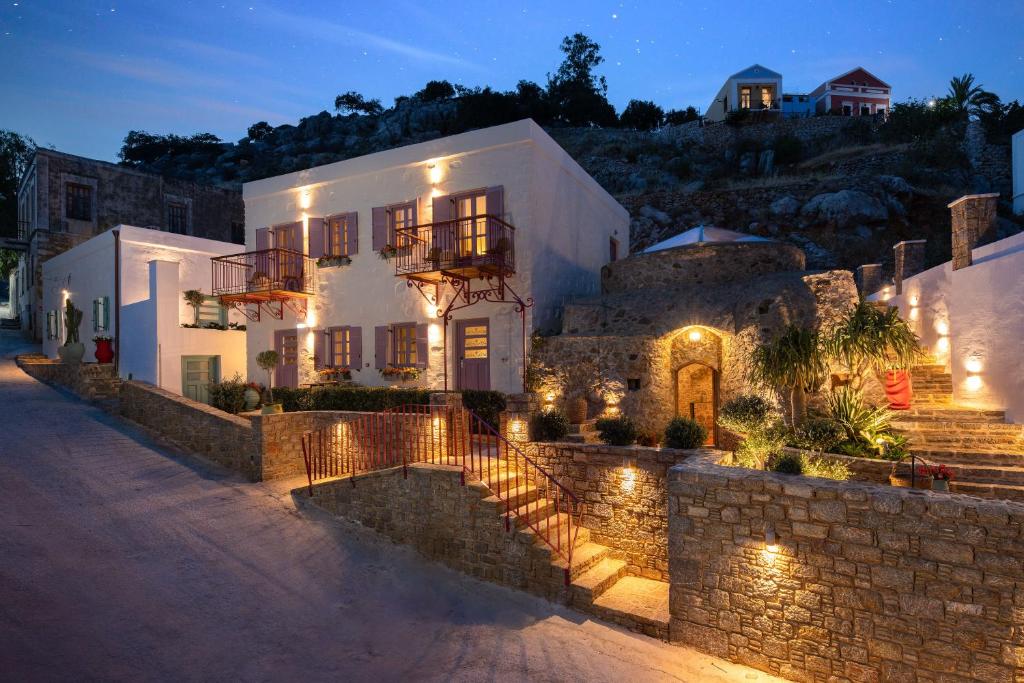
Kaminos Boutique Hotel
A more polished boutique option near the harbour, blending traditional Symi styling with modern rooms.
Check Prices & AvailabilityChorio: best for atmosphere
Chorio is quieter and more residential, especially in the evening. You trade harbour-level convenience for views and atmosphere.

Sevasti Symi Studios
A quieter upper-town stay with views and easy access to the atmosphere of Chorio.
Check Prices & AvailabilityPedi: best for swimming
Pedi is a good compromise if you want a calm seaside base while staying close enough to Chorio and the rest of town.

Korali Hotel
A seaside Pedi option for travelers who would rather wake up beside a calm bay than in Gialos.
Check Prices & AvailabilityNimborio: best for seclusion
Nimborio is quieter again and works when the isolation itself is part of the reason for coming.

Nireus Hotel
A seaside base for travelers who want to be removed from the main harbour activity.
Check Prices & AvailabilityBest time to visit Symi
| Period | What it feels like | Best for |
|---|---|---|
| April–May | Green hills, mild temperatures and fewer visitors. | Walking, photography and exploring. |
| June | Warm and fully awake without the peak pressure of August. | Best all-round balance. |
| July–August | Hot, busy and expensive, especially during day-trip hours. | Swimming and maximum ferry frequency. |
| September | Warm sea and gradually fewer visitors. | Another excellent all-round period. |
| October | Quieter, cooler and more seasonal. | Walking and a slower trip. |
| Around 8 November | The Panormitis pilgrimage transforms the island. | Religious tradition and local culture. |

How to Get Around Symi
Symi is small, but its steep terrain means the best transport depends on where you are going. Gialos and Chorio are easy to combine on foot if you are comfortable with stairs, while Pedi, Panormitis and the more remote beaches are easier by bus, taxi, boat or rental vehicle.
By bus
There is public transportation in Symi in the form of two bus lines:
- Bus between Gialos, Chorio and Pedi with the “Lakis” line. For information about the latest timetables, call (+30) 694 531 6248 or (+30) 697 669 4999.
- Bus between Symi Town and Panormitis Monastery. For the latest timetables, call (+30) 22460 71311.
The Gialos–Chorio–Pedi bus is particularly useful if you do not want to climb the Kali Strata both ways. For Panormitis, check the return time before leaving — I learned that one the hard way.
By taxi
Here are the phone numbers of taxi drivers in Symi:
- Charisopoulos Thanasis: (+30) 6946568731
- Kourdoumbas Stamatis: (+30) 6945226348
- Makropoulos Giannis: (+30) 6945531676
- Nikolis Giannis: (+30) 6987569469
- Petridis Georgios: (+30) 6974623492
- Tsavaris Konstantinos: (+30) 6944105596
Saving a few numbers before arrival is useful because Symi does not have the same on-demand taxi availability you might expect in a large city.
By car or scooter
There are a handful of car rental companies in Symi. Panormitis Travel Car Rental and Revel Rentals are the ones with the best reviews.
They also rent scooters.
I would not automatically rent a vehicle for a short first stay, because much of Symi’s appeal is reached on foot or by boat. A car or scooter becomes much more useful if you want to visit Panormitis on your own timetable, reach road-accessible beaches such as Toli or Marathounda, or explore several inland stops in one day.
Renting a boat in Symi
This is also possible in Symi and can be a very good way to move around if you are a group.
Symi Coral and Rent Boat Yannis are two well-known companies.
Renting your own small boat gives you far more flexibility than the scheduled taxi boats if you want to combine several coves and stay as long as you like.

Walk Gialos and Chorio, use the local bus for Pedi, take water taxis for the boat-only beaches, and only rent a car or scooter if you specifically want independent access to Panormitis and the road-accessible parts of the island.
Money and ATMs in Symi
Cards are widely usable around Gialos, but I would still carry cash for smaller businesses, beach boats and places away from the harbour.
If an ATM offers to convert the withdrawal into your home currency, I decline the conversion and let my own card provider handle the exchange rate.
I use Wise for travel spending and foreign-currency withdrawals because it lets me manage multiple currencies without relying on airport exchange counters.
See the Account I UseI also use N26 for everyday card payments while traveling, which gives me another practical backup when I do not want to rely on one account.
See My Travel Banking OptionMobile coverage and eSIMs in Symi
Gialos and Chorio generally have straightforward mobile coverage. Remote coves, hiking routes and stretches offshore are where service becomes less predictable.
If you already have EU/EEA roaming included in your normal plan, you may not need another eSIM. Otherwise, compare the host network as well as the price.
I keep the current provider comparisons in my Greece eSIM guide rather than repeating changing prices here.
If I want data installed before arriving, Airalo is one of the options I compare alongside the other Greece eSIM providers.
Check the Current PlanPractical Symi tips that matter once you are there
The Kali Strata, Chorio lanes, hiking trails and pebble beaches make proper footwear useful.
Use mornings and evenings for stairs and town walks; midday is better for the sea, lunch or shade.
Cards are common, but small tavernas, boats and businesses outside Gialos can be less predictable.
This applies to beach boats, Panormitis buses and inter-island ferries. The return timetable often controls the day.
Dodecanese island hopping from Symi
Symi works particularly well as part of a Dodecanese route because Rhodes provides a major transport gateway while several smaller islands sit naturally farther along the regional ferry network.
- Rhodes + Symi: medieval city scale followed by a compact maritime island.
- Symi + Nisyros: pastel neoclassical harbour followed by a volcanic landscape.
- Symi + Kalymnos: two islands tied historically to sponge diving but with very different personalities.
- Symi + Patmos: particularly good if religious history matters to you.
- Symi + Kastellorizo: a more remote pairing that normally uses Rhodes as the connection point.
For the wider route logic, use my quiet Dodecanese guide and Greek island-hopping itineraries.

Symi travel FAQ
How many days do you need in Symi?
I would stay two or three nights. Two lets you experience the harbour after the day visitors leave; three gives you more room for a proper beach or boat day and Panormitis.
Is Symi worth visiting from Rhodes?
Yes. Gialos alone makes it a worthwhile excursion, but staying overnight gives you a much fuller sense of the island.
Do you need a car in Symi?
Usually not. Gialos and Chorio are explored on foot, buses serve Pedi and Panormitis, and many of the best beaches are reached by boat. Renting a car or scooter becomes more useful if you want independent access to Panormitis and road-accessible beaches.
Is there public transport in Symi?
Yes. One bus service connects Gialos, Chorio and Pedi, while another runs between Symi Town and Panormitis Monastery. Because schedules can change, use the phone numbers in the transport section above to check current times.
Where is the best place to stay in Symi?
Gialos is best for transport and restaurants, Chorio for atmosphere, Pedi for swimming and Nimborio for seclusion.
Which beach is best in Symi?
Agios Georgios Dysalonas is the most dramatic; Nanou is excellent for a longer comfortable beach day; Agios Nikolaos works well if you want facilities.
Can you walk from Gialos to Chorio?
Yes. The Kali Strata links them with roughly 500 steps. Avoid the hottest part of a summer afternoon.
When is the best time to visit Symi?
June and September offer a particularly good balance. Spring and October are better if walking matters more than swimming.
Is Symi good for island hopping?
Yes. Rhodes is the main hub, while Nisyros, Tilos, Kos, Kalymnos and other Dodecanese islands can be incorporated into longer regional routes.
Why I think Symi is worth staying for
Symi’s harbour is beautiful enough that it can almost work against the island. It is easy to arrive, take the photograph, eat beside the water and assume you have understood the place.
Staying longer changes that. Gialos becomes quieter, Chorio stops being simply the top of a staircase, Panormitis introduces a religious tradition that still matters, and the boat-only beaches make the shape of the island much clearer.
That is the version of Symi I would travel for: not just the colourful harbour, but the relationship between a maritime town, a steep island interior, pilgrimage routes, hidden coves and the wider Dodecanese.
A wider look at Symi’s harbour, coast and landscapes.
If Symi is one stop in a longer trip, continue with my quiet Dodecanese guide or build the route with my Greek island-hopping itineraries.
Last Updated on 03/10/2026 by Panos


Very nice website with great pictures and good description.
Thanks a lot, Gisela. I try to be helpful and objective.
Spread the word! 🙂