

10 Best Buddhist Monasteries in Mongolia: Which Ones Are Worth Visiting?
Mongolia has monasteries scattered from central Ulaanbaatar to remote valleys, forested mountains and the edge of the Gobi. The problem is not finding a list of them. It is working out which monasteries actually deserve space in your itinerary and which ones fit naturally together.
After traveling across Mongolia, I stopped thinking of these sites as interchangeable temples. Gandan showed me living urban Buddhism. Erdene Zuu connected Buddhism directly with the former Mongol capital. Amarbayasgalant was about architectural survival and isolation, while Tövhön made far more sense as a mountain retreat than as another sightseeing stop.
This guide ranks the monasteries I think are most useful to travelers, explains what makes each one different, and shows how to group them into realistic routes rather than driving across Mongolia simply to collect monastery names.
Updated October 2026. Some links are affiliate links, which means I may earn a commission if you book through them at no additional cost to you.
The 4 Mongolia Monasteries I Would Prioritize
For a first trip, I would build around Gandantegchinlen in Ulaanbaatar, Erdene Zuu in Kharkhorin, Tövhön in the Orkhon Valley and Amarbayasgalant in northern Mongolia.
They are not simply the four biggest. Together they show four distinct sides of Mongolian Buddhism: a major living monastery, the country’s early Buddhist-imperial heartland, a mountain retreat and one of its best-preserved historic complexes.
10 Best Monasteries in Mongolia at a Glance
I rank these by their value to travelers, not simply by historical importance.
| Monastery | Best for | Region | Time needed | Logistics |
|---|---|---|---|---|
| 1. Erdene Zuu | First-time visitors + Mongol Empire context | Kharkhorin | 2–3 hours | Easy once in Kharkhorin |
| 2. Gandantegchinlen | Living Buddhism | Ulaanbaatar | 1.5–2 hours | Easy |
| 3. Amarbayasgalant | Architecture + remoteness | Selenge | Half day | Long road trip |
| 4. Choijin Lama | Buddhist art + Tsam masks | Ulaanbaatar | 1–2 hours | Very easy |
| 5. Tövhön | Mountain retreat + Zanabazar | Orkhon Valley | Half day | Rough road + hike |
| 6. Aryabal | Easy monastery + scenery | Gorkhi-Terelj | 1–2 hours | Easy day trip |
| 7. Khamar | Danzanravjaa + Gobi spirituality | Dornogovi | Half day+ | Best via Sainshand |
| 8. Ongi | Ruins + 1930s history | Middle Gobi | 2–3 hours | Best on Gobi–Kharkhorin route |
| 9. Dashchoilin | Mongolian ger-style architecture | Ulaanbaatar | 1 hour | Easy |
| 10. Shankh | Quiet historical stop | Near Kharkhorin | 1 hour | Driver useful |
The Smartest Tours for Seeing Mongolia’s Monasteries
Most of the important countryside monasteries are not isolated day-trip attractions. They work better when included naturally in a wider Mongolia route.
That is why I would not search for a generic “Mongolia monastery tour.” Instead, choose a tour whose geography already passes the monastery you want to see.
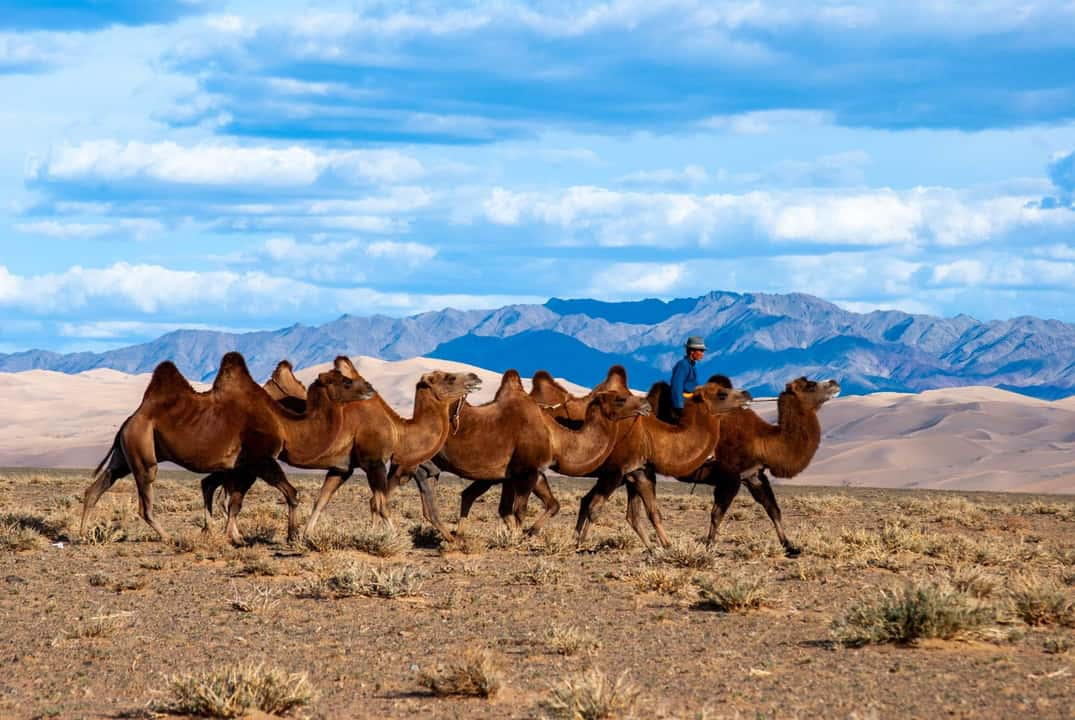
8-Day Gobi & Central Mongolia Tour
This is the more efficient choice if you want to combine the desert with Mongolia’s historic center rather than returning to Ulaanbaatar between regions.

Terelj & Chinggis Khaan Statue Day Trip
If you have only one spare day in Ulaanbaatar, this is the easiest way to combine a countryside excursion with the Aryabal area rather than arranging separate transport into Terelj yourself.
Where the Monasteries Fit Into a Mongolia Route
Zoom around my route map to see why Erdene Zuu, Tövhön, Ongi and Amarbayasgalant work much better as stages of an overland journey than as individual returns from Ulaanbaatar.
Erdene Zuu Monastery – Kharkhorin
Best monastery for a first Mongolia trip
If I could send a first-time visitor to only one historic monastery in Mongolia, I would choose Erdene Zuu.
It is not simply because it is regarded as Mongolia’s oldest surviving Buddhist monastery. Its real value is geographic and historical. Erdene Zuu stands beside the remains of Karakorum, the former capital of the Mongol Empire, so the transition from imperial center to Buddhist religious center is visible in the same landscape.
Abtai Sain Khan commissioned the monastery in the late 16th century after the renewed adoption of Tibetan Buddhism among the Khalkha Mongols. Stone and other material from the abandoned city were reused in the complex.
The most immediately recognizable feature is the perimeter wall lined with 108 white stupas. Inside, surviving temples combine Chinese, Tibetan and Mongolian architectural influences, while sections of the complex continue to function as a religious site.
I arrived while monks were praying, and that changed the experience completely. The chanting made the site feel like a living continuation of the history around it rather than an archaeological attraction.

Gandantegchinlen Monastery – Ulaanbaatar
Best place to see living Mongolian Buddhism
Gandan is the monastery I would prioritize in Ulaanbaatar, particularly if you want to see Buddhism as a living religion rather than only through historical buildings.
Gandantegchinlen developed during the 19th century and survived the communist period in a radically reduced form before Buddhist practice expanded again after Mongolia’s democratic transition.
Its best-known building is the Migjid Janraisig Temple, which contains the enormous 26.5 m (87 ft) Avalokiteshvara statue. Yet the atmosphere outside the main temple mattered more to me: pilgrims turning prayer wheels, monks moving between buildings and morning chanting inside the halls.
That activity makes Gandan fundamentally different from Choijin Lama Temple Museum a little farther into the city. One remains a major working religious center; the other preserves Buddhist ritual art in a museum context.

Amarbayasgalant Monastery – Selenge Province
Best combination of architecture, atmosphere and remoteness
Amarbayasgalant was one of the monasteries whose setting affected me as much as the architecture itself.
Constructed in the 18th century in honor of Zanabazar, Mongolia’s first Jebtsundamba Khutuktu, the complex follows a strongly symmetrical plan with predominantly Chinese architectural influence alongside Mongolian and Tibetan religious elements.
The monastery suffered during the political repression of the late 1930s, but more of its central architecture survived than at many other major Mongolian monasteries. That gives Amarbayasgalant a visual coherence that is difficult to find elsewhere.
When I visited, the surrounding Iven Valley amplified the experience. The monastery did not feel like an urban monument transplanted into the countryside. Herds, grassland and mountains were part of the setting.

If Amarbayasgalant is important to you, I would sleep near the monastery instead of trying to force it into a rushed return trip from Ulaanbaatar.
My dedicated guide explains the road, ger-camp options and what I found on site: how to visit Amarbayasgalant Monastery.
Choijin Lama Temple Museum – Ulaanbaatar
Best for Buddhist art, masks and ritual objects
Choijin Lama deserves a place in this guide with one important qualification: today it functions as a museum rather than an active monastery.
That is actually why I think it complements Gandan so well.
The early-20th-century temple complex preserves some of the most compelling Buddhist ritual art I saw in Mongolia, including dramatic Tsam masks, thangka paintings, sculptures and ceremonial objects.
At Gandan you watch religious life continue. At Choijin Lama you can slow down and study the objects, iconography and craftsmanship that formed part of that religious world.

Tövhön Monastery – Orkhon Valley
Best monastery where the journey is part of the experience
Tövhön is the monastery on this list that I think travelers most easily underestimate.
It is not a grand complex like Amarbayasgalant, and that is not the point. Zanabazar established the retreat in the 17th century high in the forested mountains of the Orkhon region. The site became closely associated with his meditation, religious scholarship and artistic work.
Reaching it involves rougher countryside roads and then walking uphill through larch forest. By the time you reach the small temples and rock formations near the summit, the separation from the valley below becomes part of the monastery’s meaning.
This was one of the clearest examples in Mongolia of religious architecture responding directly to landscape.

Aryabal Meditation Temple – Gorkhi-Terelj
Best monastery-style stop on an easy Ulaanbaatar day trip
Aryabal is not one of Mongolia’s great historical monastic complexes. I include it because for travelers its setting and accessibility make it genuinely worthwhile.
The temple sits high on a wooded hillside in Gorkhi-Terelj National Park. Prayer flags and Buddhist signs line the uphill path, and the elevated position opens views across the surrounding granite formations and forest.
I visited Aryabal as part of my day trip combining Terelj with the Chinggis Khaan Statue Complex. That pairing worked extremely well because the monastery adds a quieter, contemplative element to what can otherwise become a straightforward sightseeing circuit.

Read my complete Terelj and Chinggis Khaan Statue day-trip guide for the route I followed.
Khamar Monastery – Dornogovi
Best monastery for a very different Gobi spiritual tradition
Khamar is the monastery on this list that feels least connected to the standard Kharkhorin–Ulaanbaatar monastery circuit.
It was established around 1820–21 by the extraordinary Gobi religious figure, poet, educator and artist Danzanravjaa. Before its destruction during the late-1930s repression, Khamar developed into a major religious, educational and cultural center.
The significance of Khamar extends beyond reconstructed monastery buildings. The wider sacred landscape includes meditation sites and places associated with the Mongolian interpretation of Shambhala, which continues to attract pilgrims.
This makes it a very different experience from Erdene Zuu or Amarbayasgalant. I would visit Khamar because you are interested in Danzanravjaa and the spiritual geography of the eastern Gobi, not simply because you are trying to complete a top-ten list.
Ongi Monastery – Middle Gobi
Best monastery ruins on the Gobi–Central Mongolia route
I would put Ongi in the Top 10 before trying to force Baga Gazriin Chuluu into a monastery list.
The former Ongi complex once spread across both sides of the Ongi River and developed into one of Mongolia’s important monastic centers before being destroyed during the communist repression.
Today the attraction is the contrast between ruined walls, empty foundations and the small revived religious presence beside them.
Ongi also has something most remote monasteries lack: excellent route logic. It lies naturally between the Gobi and Kharkhorin, so I visited it while moving north rather than making a separate detour.

I cover the surviving ruins, history, accommodation and road logistics in my dedicated Ongi Monastery travel guide.
If you are approaching from the south, my 5-day Gobi Desert itinerary shows the route that feeds naturally into Ongi and then Central Mongolia.
Dashchoilin Monastery – Ulaanbaatar
Best place to notice Mongolia’s ger-shaped temple architecture
Dashchoilin is easy to overlook because it lacks the scale and fame of Gandan, but architecturally it adds something genuinely different.
The modern monastery occupies surviving and revived elements associated with the old Eastern Khüree, one of the major monastic districts of historical Ulaanbaatar.
Its most distinctive buildings are the rounded, ger-shaped temple halls. That form matters because Mongolian Buddhist architecture did not simply copy Tibetan or Chinese monasteries; it also adapted the geometry of the nomadic ger into permanent religious buildings.
The old article described Dashchoilin as having survived the 1930s purges largely intact. That is too simple. The wider Eastern Khüree was devastated, while some unusual temple structures survived through later secular uses before religious life was re-established after 1990.

Shankh Monastery – Near Kharkhorin
Best quiet monastery to add to a Central Mongolia route
Shankh does not need to be a headline destination to be worth visiting.
Founded in the 17th century and closely associated with Zanabazar, it developed into an important monastic center southeast of Kharkhorin.
Its history through the repression period is complicated. Much of the larger complex was lost and the monastery closed, but religious knowledge and parts of the site’s heritage survived, allowing monastic life to be revived after the democratic transition.
What I liked most was the contrast with Erdene Zuu. Erdene Zuu is monumental and historically unavoidable. Shankh is smaller, quieter and much easier to experience without a stream of visitors moving through the same courtyard.
Bonus Sacred Landscape: Baga Gazriin Chuluu
I kept it in this guide because of its Buddhist history, but it is not a monastery in the conventional sense.
Why Baga Gazriin Chuluu Still Belongs in the Conversation
Baga Gazriin Chuluu is a dramatic granite massif in Dundgovi Province with caves, rock formations and traces associated with Buddhist meditation and retreat.
The landscape helps explain an important theme that appears repeatedly across Mongolia: religious practice did not always require monumental architecture. Isolation, caves, mountains and retreat sites could be just as important.
I would visit Baga Gazriin primarily for the landscape and sacred-site context, not because you are expecting another Erdene Zuu or Amarbayasgalant.
Bonus: Manzushir Monastery Ruins Near Ulaanbaatar
This is the addition I would consider if you want another monastery-focused day without committing to a multi-day Central Mongolia route.
Manzushir was established in the 18th century on the southern side of Bogd Khan Mountain and grew into a substantial monastery before being destroyed during the communist repression.
A restored building now serves as a museum, while ruined foundations and forested mountain scenery make the site feel completely different from Ulaanbaatar’s active monasteries.
Its biggest advantage is practical: you can reach it as a day trip from Ulaanbaatar. It is a particularly good choice if you want Buddhist heritage combined with light hiking and a quieter mountain setting rather than another full day in the city.

Manzushir Monastery Day Trip
This is the tour I would consider if you want to leave Ulaanbaatar for a quieter cultural day without committing to a long overland journey. Manzushir combines monastery ruins, forested mountain scenery and walking in the Bogd Khan area.
How I Would Combine Mongolia’s Monasteries
This is where a useful monastery guide should beat a simple Top 10 list.
My complete 3-week Mongolia itinerary shows how several of these monasteries fit into a single route from Ulaanbaatar to the Gobi, Central Mongolia, Khuvsgul and back south.
Want Someone Else to Handle the Full Mongolia Logistics?
A longer organized tour makes more sense if monasteries are one part of a wider first trip rather than the sole focus.

16-Day Mongolia Overland Tour
This is the kind of trip I would consider if you want Mongolia’s cultural sites as part of a much bigger journey through the Gobi, countryside and northern regions rather than building every remote transfer yourself.
Can You Visit Mongolia’s Monasteries With a Rental Car?
Some are easy. Others are precisely where Mongolia’s road conditions start to matter.
Gandan, Dashchoilin and Choijin Lama need no rental car at all. Kharkhorin is comparatively straightforward by Mongolian standards.
The equation changes for Tövhön, deeper Orkhon Valley roads, Amarbayasgalant, Ongi and remote Gobi sites. Tracks can become rough or muddy, navigation may involve several parallel dirt routes and mobile reception can disappear.
I would self-drive those areas only if you already have experience with remote-road travel. Otherwise, a local driver is usually the better use of your time.

Compare Rental Cars in Mongolia
If you are building an independent monastery route, compare vehicles carefully. For remote countryside sections I would specifically check ground clearance, 4WD capability, unpaved-road restrictions, mileage, spare tires and roadside support.
Compare Rental CarsWhy Mongolia’s Monasteries Feel So Different From One Another
Mongolia’s Buddhist heritage cannot be understood as one uninterrupted architectural tradition.
Monasteries expanded dramatically after Tibetan Buddhism became increasingly influential among Mongolian rulers from the 16th century onward. Some complexes adopted Chinese planning and roof forms, others Tibetan religious architecture, while Mongolian builders also developed forms inspired by the circular geometry of the ger.
Then came the political purges of the late 1930s. Monastic institutions across the country were dismantled, buildings were destroyed or repurposed and thousands of monks were killed, imprisoned or forced into secular life.
That rupture is why the monasteries on this list tell such different stories.
- Erdene Zuu: survival beside the former imperial capital.
- Gandan: continuity and revival in the capital.
- Amarbayasgalant: unusually extensive surviving architecture.
- Dashchoilin: surviving architectural fragments absorbed into a revived monastery.
- Ongi: destruction visible directly in the landscape.
- Khamar: a sacred complex reconstructed around the legacy of Danzanravjaa.
Once I understood that, visiting monasteries stopped feeling repetitive. Each site became another chapter in the same historical story.
Buddhist Monastery Etiquette in Mongolia
- Dress reasonably modestly when entering active temple buildings.
- Remove hats where local practice requires it.
- Walk clockwise around stupas, sacred objects and prayer circuits unless instructed otherwise.
- Do not interrupt monks or worshippers for photographs.
- Always check whether interior photography is allowed.
- Keep voices low during chanting and ceremonies.
- Do not touch statues, thangkas, ritual instruments or offerings.
- Opening access can change during religious services, so avoid building an extremely tight schedule around published hours.
Buddhist Monasteries in Mongolia FAQ
What is the best monastery to visit in Mongolia?
For a first trip, I would choose Erdene Zuu because it combines Buddhist history with Karakorum and the wider Orkhon Valley. If you want to see contemporary religious practice, Gandantegchinlen in Ulaanbaatar is the stronger choice.
What are the three most important monasteries in Mongolia?
Gandantegchinlen, Erdene Zuu and Amarbayasgalant are the three I would prioritize for their combination of religious importance, historical significance and value to travelers.
What is the oldest Buddhist monastery in Mongolia?
Erdene Zuu, founded in the late 16th century beside Karakorum, is generally regarded as Mongolia’s oldest surviving Buddhist monastery.
Which Mongolia monastery is easiest to visit?
Gandantegchinlen is easiest because it is inside Ulaanbaatar. Choijin Lama Temple Museum and Dashchoilin are also easy city visits.
Which monastery has the best architecture?
Amarbayasgalant would be my choice. Its surviving 18th-century complex has a strong symmetrical plan and one of the most visually coherent historic monastery settings in Mongolia.
Which monastery is best near Kharkhorin?
Erdene Zuu is essential. If you have extra time, add Shankh and then continue into the Orkhon Valley toward Tövhön.
Can I visit monasteries independently in Mongolia?
Yes. Ulaanbaatar monasteries are simple to visit independently, and Kharkhorin is relatively accessible. More remote places such as Amarbayasgalant, Tövhön and Ongi are easier with a private driver, rental 4WD or organized tour.
Is Choijin Lama Temple still an active monastery?
No. It functions as the Choijin Lama Temple Museum. That distinction makes it particularly useful for studying Buddhist art, ritual objects and Tsam masks.
Is Baga Gazriin Chuluu a monastery?
No. It is primarily a granite sacred landscape with historical associations with Buddhist retreat and meditation. I include it as a bonus rather than counting it among the Top 10 monasteries.
Can I combine Mongolia’s monasteries with the Gobi Desert?
Yes. One of the strongest routes is the South Gobi followed by Ongi Monastery, Kharkhorin, Erdene Zuu and the Orkhon Valley. This avoids returning to Ulaanbaatar between the desert and Central Mongolia.
Mongolia’s Monasteries Make More Sense as a Journey Than a Checklist
The mistake I would avoid is trying to visit monasteries simply because they appear on a “must-see” list.
Mongolia is too large for that.
Instead, I would use the monasteries to add historical depth to the route you are already taking.
Visit Gandan because you are in Ulaanbaatar. See Erdene Zuu and Shankh because you are crossing Central Mongolia. Make time for Tövhön because the Orkhon Valley interests you. Stop at Ongi when moving north from the Gobi. Reach Amarbayasgalant while returning from northern Mongolia.
That is how these places worked for me. They stopped being isolated temples and became markers of how Mongolia changed from empire to Buddhist state, through repression and into religious revival.
Last Updated on 06/10/2026 by Panos


