

Orkhon Valley Mongolia: 2-Day Itinerary, Map & Best Stops
The Orkhon Valley makes much more sense once you stop thinking of it as one attraction. Kharkhorin is the historical gateway, with the remains of Karakorum, Erdene Zuu Monastery and museums. Farther into the valley, paved roads give way to rougher tracks leading toward herding communities, the Orkhon Waterfall and the forested mountain retreat of Tövhön Hiid.
I reached the valley after traveling north from the Gobi Desert through Ongi Monastery. Over two busy days, I moved from the former capital of the Mongol Empire to living Buddhist monasteries, a traditional calligraphy center, horseback riding, volcanic landscapes and the upper Orkhon Valley.
Two days can cover the major highlights if you already have a vehicle and are comfortable with a fast second day. If Orkhon Waterfall, Tövhön and time on horseback all matter to you, I would now allow three days. Distances are not enormous on a map, but rough roads make them much slower than they look.
Updated October 2026. This guide reflects my own route and current information on the UNESCO landscape, road logistics, waterfall seasonality and organized tour options.
This article contains affiliate links. If you book through them, I may earn a commission at no extra cost to you.
How Long Do You Need in the Orkhon Valley?
Two days is the minimum I would recommend: one full day for Kharkhorin and its cultural sites, followed by one long day deeper into the valley.
Three days is better if you want the waterfall, Tövhön Hiid and a meaningful horse ride without turning the experience into a race between rough-road transfers.

A Completely Different Way to See the Orkhon Valley
Driving is the practical way to cover the highlights quickly, but it is not the only way to experience Central Mongolia. If cycling is already part of how you like to travel, this is one of the few organized Mongolia trips I found that turns the journey itself into the main experience rather than simply transporting you between attractions.

11-Day World Heritage Orkhon Valley Cycling Tour
This supported cycling journey crosses the wider Central Mongolian landscape through river valleys, mountain passes and open steppe before reaching the UNESCO-listed Orkhon Valley and Kharkhorin. It is a very different proposition from a two-day sightseeing loop: the slower pace lets the distances, herding landscape and terrain become part of the trip itself.
What Exactly Is the Orkhon Valley?
The Orkhon Valley Cultural Landscape is much larger than Kharkhorin. UNESCO’s inscribed area covers roughly 121,967 hectares of pastureland along the Orkhon River and preserves evidence of successive cultures and empires that used this landscape for political, religious and pastoral life.
That includes the ancient Mongol capital of Karakorum, Erdene Zuu, Tövhön Hermitage, Shankh Monastery and remains associated with earlier Turkic and Uyghur states.
More importantly, this is still a living pastoral landscape. Families continue moving livestock through the grasslands that supported earlier steppe societies. That continuity between archaeology, political power and mobile pastoralism is a major reason UNESCO listed the valley in 2004.
My Mongolia Route Map
Zoom into Central Mongolia to see Kharkhorin and the wider Orkhon region in relation to the Gobi, Ongi and the northern route. The map also shows why continuing north from the Gobi creates a much more coherent journey than returning to Ulaanbaatar between regions.
2 Days vs 3 Days in the Orkhon Valley
Orkhon Valley 2-Day Itinerary
| Day | Main stops | Overnight | Pace |
|---|---|---|---|
| Day 1 | Karakorum history → Erdene Zuu → Karakorum Museum → Mongolian Calligraphy Center → optional Shankh | Kharkhorin or nearby ger camp | Culture-heavy but geographically compact |
| Day 2 | Monument for Mongol States → horseback ride → upper Orkhon Valley → Ulaan Tsutgalan → Tövhön area | Orkhon Valley ger camp | Long and much more road-dependent |
If I had a third day, I would move Tövhön entirely onto Day 3. That removes the pressure to rush the waterfall or shorten the horse ride because one rough section of road took longer than expected.
Kharkhorin: From the Mongol Empire to Living Buddhism
Kharkhorin is where the history becomes tangible.
Modern Kharkhorin stands beside the archaeological remains of Karakorum, the imperial center established in the Orkhon Valley in the early 13th century. Chinggis Khaan established the site around 1220, while his son Ögedei developed it into a permanent walled capital in the 1230s.
Its location was not accidental. The Orkhon Valley had already been a center of power for earlier steppe states, and the Mongols inserted their capital into a landscape with centuries of political significance.

A Capital Connected to Eurasia
Under Ögedei, Karakorum developed palaces, workshops, markets and religious buildings. Craftspeople, merchants, diplomats and religious communities arrived from across the Mongol Empire.
One of the most famous descriptions comes from the 13th-century traveler William of Rubruck, who wrote about the extraordinary Silver Tree at the khan’s palace — an elaborate fountain associated with a European metalworker at the Mongol court.
Karakorum’s importance declined after Kublai Khan shifted the imperial center toward what is now Beijing. Ming forces later destroyed the city in 1388.
Erdene Zuu Monastery: Where Imperial and Buddhist Mongolia Meet
My first major stop in Kharkhorin was Erdene Zuu, one of the most important monasteries I visited in Mongolia.
Abtai Sain Khan established the monastery in the late 16th century, traditionally dated to 1585. Building material from the abandoned imperial capital was reused, physically connecting Karakorum’s political past with Mongolia’s later Buddhist history.

The compound is surrounded by its famous wall of white stupas. Inside, the atmosphere changes completely. Temple roofs, prayer wheels, thangka paintings and surviving religious buildings occupy what feels almost like a small sacred city inside the walls.


I happened to arrive as monks were praying. The low chanting, incense and old wooden interiors made Erdene Zuu feel fundamentally different from an archaeological attraction.
That distinction matters. The ancient capital beside it is largely a landscape of foundations, artifacts and reconstruction, while Erdene Zuu remains a place of worship.


The monastery suffered devastating losses during the anti-religious purges of the 1930s. Parts survived as a museum, and religious life returned after Mongolia’s democratic transition.


Karakorum Museum: Do Not Skip the Context
The Karakorum Museum is small enough to fit easily into the same day, but I would not skip it.
The surrounding ruins are difficult to interpret without context. Inside the museum, archaeological finds help reconstruct a city that was far more cosmopolitan than its sparse remains suggest.
Ceramics, coins, architectural fragments and objects connected with trade reveal Karakorum’s role in a transcontinental empire. The displays also help explain the Silver Tree, imperial administration and the city’s later destruction.

Erdenesiin Khuree Mongolian Calligraphy Center
One of my favorite smaller stops in Kharkhorin was the Erdenesiin Khuree Mongolian Calligraphy Center.
This was completely different from the large historical sites. The exhibitions were arranged inside gers, where calligraphers were actively working with the traditional vertical Mongolian script.
UNESCO placed Mongolian calligraphy on its List of Intangible Cultural Heritage in Need of Urgent Safeguarding in 2013. Seeing it practiced rather than simply displayed made that heritage feel much more immediate.
A local artist showed me how the strokes are formed and then helped me write my own name. My first attempts were predictably shaky, but trying it made me notice the balance and rhythm in the script in a completely different way.

Shankh Monastery: The Quiet Alternative Near Kharkhorin
If time allows, add Shankh Monastery, roughly 25 km (16 mi) south of Kharkhorin.
Shankh dates from the mid-17th century and is closely associated with Zanabazar, the first Jebtsundamba Khutuktu and one of the defining figures in Mongolian Buddhist history.
Compared with Erdene Zuu, Shankh feels much quieter and more intimate. The surrounding grasslands reinforce the sense that you have moved away from Kharkhorin’s main visitor circuit.
I would treat it as an optional Day 1 extension rather than sacrificing Erdene Zuu or the Karakorum Museum to fit it in.
Into the Orkhon Valley: Horses, Waterfall & Sacred Mountains
Day 2 is where the trip stops feeling like a visit to Kharkhorin and becomes a journey through the wider Orkhon landscape.
The roads are rougher, distances take longer and the valley becomes increasingly pastoral. This is the side of Orkhon that gets lost when itineraries simply list the waterfall and Tövhön as if they were neighboring roadside attractions.
Start With the Monument for Mongol States
Before heading deeper into the valley, I climbed the hill above Kharkhorin to the Monument for Mongol States, sometimes called the Imperial Map Monument.
The monument represents three major steppe powers associated with this region: the Xiongnu, Turkic states and the Mongol Empire.
More important than the monument itself is the viewpoint. From the top, Kharkhorin, the Orkhon River and the huge surrounding grasslands suddenly fit together geographically.


Horseback Riding Through the Valley
After breakfast I met a local herder, Baatar, and headed into the grasslands on a Mongolian horse.
Riding changes the scale of the valley. In a vehicle, the grassland passes quickly. On horseback, you begin noticing grazing patterns, streams, ovoos and the long gaps between family camps.
We passed livestock and seasonal camps while Baatar pointed out ovoos — sacred stone cairns often wrapped in blue khadag scarves. Where local custom invites participation, travelers traditionally circle an ovoo clockwise.
At one family camp I was offered boortsog, fried dough, and suutei tsai, Mongolia’s salty milk tea. Conversations about pasture, winter conditions and seasonal movement gave me a much clearer idea of why UNESCO describes Orkhon as a continuing cultural landscape rather than simply an archaeological site.
Orkhon Waterfall (Ulaan Tsutgalan)
The best-known natural sight in the valley is Ulaan Tsutgalan, generally called Orkhon Waterfall by travelers.
The waterfall drops approximately 24 m (79 ft) into a basalt gorge created where river erosion cut through ancient volcanic rock.
What photographs do not tell you is that water volume varies enormously. After summer rain, the falls can be powerful and the gorge fills with spray. During a dry period, flow can be dramatically reduced.
That means I would never plan an entire Central Mongolia journey around seeing the waterfall at maximum volume.
I ate a simple picnic near the rim, then followed the path down toward the base. The lower viewpoint makes the volcanic structure of the gorge much easier to appreciate.

Tövhön Hiid: The Stop That Deserves More Time Than It Gets
Tövhön was the stop I most underestimated when looking at the itinerary.
This is not a monastery sitting beside a highway. Tövhön is a mountain hermitage surrounded by forest, with the final approach requiring a rough drive followed by a substantial uphill walk.
The hermitage sits at roughly 2,600 m (8,530 ft) in the Shiveet Ulaan Mountains. Exact walking distance depends on how far road conditions allow your vehicle to approach, but I would plan for several kilometers on foot rather than treating Tövhön as a quick photo stop.
Zanabazar established his retreat here in the 17th century. The site became associated with his meditation, art and religious scholarship and is specifically identified by UNESCO as one of the places connected with the development of a distinctive Mongolian Buddhist tradition.
The monastery itself is modest. What makes it extraordinary is the setting: wooden temples among larch forest, rock formations, meditation caves and huge views from the mountain.
Sitting there reminded me of the Aryabala Meditation Center in Gorkhi-Terelj, another Mongolian religious site where the journey through the landscape is inseparable from the spiritual setting.

Combine the Orkhon Valley With the Gobi Desert
This is how Central Mongolia made the most sense on my own trip.
Instead of visiting the Gobi, returning to Ulaanbaatar and then driving west again, we continued north from Bayanzag through Ongi Monastery toward Kharkhorin.
The transition is one of the best parts of the route: red desert cliffs and open gravel gradually give way to greener river valleys, Buddhist sites and the historical core of Central Mongolia.
You can see the full version in my 3-week Mongolia itinerary, but you do not need three weeks to make the basic Gobi–Orkhon combination work.
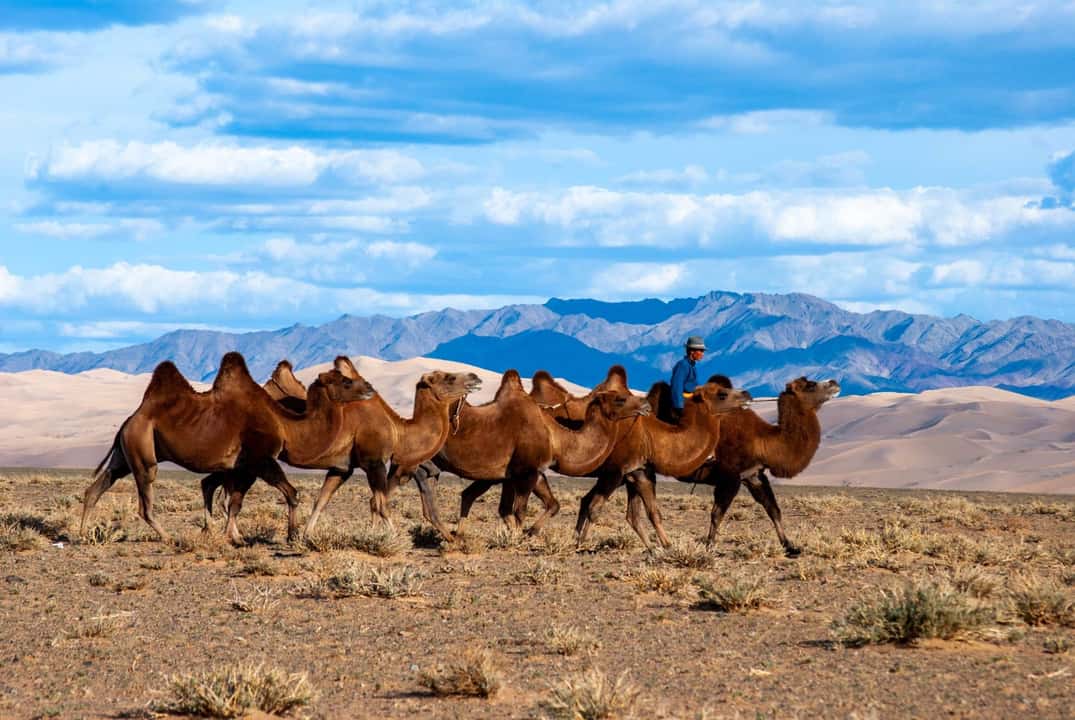
8-Day Gobi Desert & Orkhon Valley Tour
If you want both landscapes but do not have time for my three-week route, this private overland trip connects the Gobi with Ongi, the Orkhon Valley and Kharkhorin in one continuous journey.
For much more detail on the southern half of that journey, see my 5-day Gobi Desert itinerary.
How to Get to the Orkhon Valley
Ulaanbaatar to Kharkhorin
Kharkhorin lies roughly 360 km (224 mi) southwest of Ulaanbaatar. Allow most of a day for the journey once stops, traffic and real road conditions are included.
Kharkhorin itself is the easy part. The difficulty begins when you continue toward the waterfall, Tövhön and smaller family camps on the upper valley tracks.
Public Transport
Reaching Kharkhorin by bus is possible, making it one of the easier major countryside destinations to access independently.
Public transport becomes much less useful once you want to explore beyond town. Orkhon Waterfall and Tövhön are not connected by the kind of regular tourist transport that allows you to build a reliable urban-style itinerary.
Local Driver
For a two- or three-day itinerary covering the wider valley, this is the option I would choose.
A local driver does much more than transport you between pins on a map. Road conditions change, multiple dirt tracks often branch across the steppe, rain can slow travel dramatically and camp locations may not correspond neatly with online maps.
The driver therefore determines how efficiently you can combine the waterfall, Tövhön, horse riding and overnight stops.
Self-Drive
Experienced overland travelers can self-drive, but I would want a proper 4WD, offline navigation, recovery equipment, spare water and enough time to adapt the route when tracks deteriorate.
Driving Ulaanbaatar to Kharkhorin is not the difficult part. The upper valley tracks are where experience becomes much more valuable.

Compare Rental Cars in Mongolia
If you are considering a self-drive trip to Kharkhorin and the Orkhon Valley, compare vehicles carefully rather than choosing on price alone. The paved road to Kharkhorin is straightforward, but reaching Orkhon Waterfall, Tövhön and more remote parts of the valley can mean rough, muddy and deeply rutted tracks.
Best Time to Visit the Orkhon Valley
If you are traveling in July, read my Naadam Festival Mongolia guide before fixing your dates. Local celebrations do not necessarily follow exactly the same program as National Naadam in Ulaanbaatar.
Where to Stay in the Orkhon Valley
Kharkhorin
Kharkhorin is the practical base for Erdene Zuu, the museum, calligraphy center, Monument for Mongol States and Shankh.
If you are arriving from Ulaanbaatar late in the day, I would sleep here and start the historical sights the following morning rather than immediately pushing farther into the countryside.
Upper Orkhon Valley
For the waterfall, horse riding and Tövhön, staying farther into the valley makes much more sense than returning to Kharkhorin every night.
Accommodation is typically in tourist ger camps or family-run gers. Facilities vary from relatively comfortable camps with showers and charging to very basic stays with outdoor toilets and limited electricity.
I enjoyed the simplicity because nights in the countryside became part of the experience rather than simply accommodation between attractions.
What to Pack for the Orkhon Valley
- Warm layers: nights can be cold even during summer.
- Sturdy walking shoes: particularly for Tövhön and the waterfall gorge.
- Light rain layer: summer rain can arrive quickly.
- Cash in tögrög: do not rely on card payments outside Kharkhorin.
- Power bank: some ger camps have limited charging hours.
- Offline maps: mobile reception becomes unreliable deeper in the valley.
- Reusable water bottle: especially useful for the Tövhön hike.
- Sun protection: the steppe offers very little shade.
- Small daypack: useful for the waterfall and monastery hike.
Ger, Ovoo & Monastery Etiquette
The Orkhon Valley is not an open-air museum. People live, herd animals and worship here.
- Step over a ger threshold rather than standing on it.
- If food or tea is offered, receive it respectfully; using the right hand or supporting it with the left is customary.
- Ask before photographing people at close range.
- Keep voices low inside active monastery buildings.
- Follow local instructions about photography inside temples.
- If participating at an ovoo, circle clockwise.
- Do not move archaeological material or disturb burial and ritual sites.
Why the Orkhon Valley Is a UNESCO World Heritage Site
The Orkhon Valley Cultural Landscape was inscribed in 2004.
What makes the designation unusual is that it does not protect only one ruined city or one monastery. It recognizes the relationship between nomadic pastoralism, imperial centers, trade networks, archaeology and religion over more than two millennia.
The valley contains evidence associated with Turkic and Uyghur states, the Mongol imperial capital at Karakorum, Erdene Zuu, Shankh and Tövhön.
Yet livestock still graze across the same landscape.
That is what eventually made Orkhon more interesting to me than any individual monument. You are not moving between unrelated attractions. You are seeing successive political and religious systems repeatedly use the same river valley because the landscape made those societies possible.
Why Orkhon Valley Was One of My Most Important Stops in Mongolia
The Gobi impressed me through scale and geology. The Orkhon Valley did something different.
It connected the pieces of Mongolian history I had been seeing separately.
Karakorum explained how an empire rooted in mobile steppe society could become an international political center. Erdene Zuu showed what happened when Buddhist institutions became embedded in that same landscape. The calligraphy center showed tradition being actively taught rather than preserved behind glass.
Then, only a few hours away, herders were still moving animals through the grasslands.
That continuity is what makes the valley more than another stop on the road north to Lake Khuvsgul.

Orkhon Valley Mongolia FAQ
Is Orkhon Valley worth visiting?
Yes, particularly if you are interested in Mongolian history rather than only dramatic scenery. The valley combines the former Mongol capital of Karakorum, Erdene Zuu, continuing nomadic pastoralism, mountain monasteries, horseback riding and volcanic landscapes within one UNESCO cultural landscape.
How many days do I need in the Orkhon Valley?
Two full days is my minimum: one for Kharkhorin and one for the countryside. Three days is better if you want Orkhon Waterfall, Tövhön Hiid and a meaningful horse ride without rushing.
Is Kharkhorin the same as Orkhon Valley?
No. Kharkhorin is the main historical gateway and stands beside the remains of ancient Karakorum. The UNESCO-listed Orkhon Valley covers a much larger cultural landscape extending well beyond the town.
Can I visit Orkhon Valley from Ulaanbaatar in one day?
I would not. Kharkhorin alone is roughly 360 km (224 mi) from Ulaanbaatar, and the major countryside sights lie even farther beyond it. Treat Central Mongolia as a multi-day trip.
Can I reach Kharkhorin by public transport?
Yes, Kharkhorin is reachable by public transport from Ulaanbaatar. The difficulty is continuing independently to places such as Orkhon Waterfall and Tövhön, where a local driver becomes much more useful.
Do I need a 4WD for the Orkhon Valley?
A normal vehicle can reach Kharkhorin on the main road. For deeper parts of the valley, I would use a suitable high-clearance vehicle because local tracks can become rough, muddy or deeply rutted.
Does Orkhon Waterfall always have water?
Water volume varies significantly. The falls are usually most impressive after summer rain, while dry periods can reduce the flow substantially. Do not make the entire trip dependent on seeing a huge waterfall.
How difficult is the hike to Tövhön Monastery?
It is a sustained uphill walk through forest rather than an extreme mountain trek. The exact walking distance depends on where road conditions allow your vehicle to stop, so allow several hours for the complete visit rather than treating Tövhön as a short roadside stop.
What is the best time to visit the Orkhon Valley?
June through September is the main travel season. July and August usually offer the greenest landscapes and active ger camps, while summer rain can also improve the flow at Ulaan Tsutgalan.
Can I combine the Orkhon Valley with the Gobi Desert?
Yes, and I think it is one of Mongolia’s strongest first-trip routes. Continue north from Bayanzag through Ongi Monastery into Central Mongolia rather than returning to Ulaanbaatar. My Gobi Desert itinerary and 3-week Mongolia itinerary show how the route fits together.
Is the Orkhon Valley good for cycling?
Yes, particularly for travelers comfortable with multi-day active trips and variable terrain. Supported cycling allows you to experience the scale of the valley much more slowly than a vehicle-based itinerary.
The Orkhon Valley Route I Would Follow Again
I would absolutely return to the Orkhon Valley, but I would make one change: I would give it three days instead of trying to fit the deeper countryside into one very full second day.
Day 1 would remain almost exactly the same: Erdene Zuu, Karakorum Museum, the calligraphy center and the viewpoint above Kharkhorin.
Day 2 would be for horseback riding, family encounters and Ulaan Tsutgalan.
Day 3 would belong to Tövhön.
More importantly, I would still approach Central Mongolia as part of a continuous overland route. Coming from the Gobi through Ongi and then continuing toward Arkhangai and Khuvsgul revealed the historical and ecological transitions in a way that a return trip from Ulaanbaatar never could.
Last Updated on 06/10/2026 by Panos


