


São Jorge Island Itinerary: How to Spend 1, 2 or 3 Days
I crossed from Pico to São Jorge and explored the island from Velas to its coffee-growing fajãs, Topo, the north coast and the forested west. This itinerary separates the two experiences most first-time plans try to force into the same day: a scenic island road trip and the Caldeira de Santo Cristo hike.
São Jorge is the Azores island where the map lies to you most convincingly. It is only about 53 km (33 mi) long, yet the narrow ridge, steep descents, cloud, slow roads and fajãs below the cliffs mean that a short distance can consume far more of the day than expected.
That is also why I liked it so much. São Jorge still feels built around its landscape rather than around a sightseeing circuit. Coffee grows in tiny coastal microclimates, cheese remains central to the island’s identity, natural pools sit below vertical green slopes, and some of the most memorable settlements are reached by roads or trails that make you work for them.
My strongest personal memory is Fajã dos Vimes. I am a coffee lover and I have a particular weakness for rare coffees grown at the geographical fringe of where coffee should reasonably exist. Drinking coffee grown beneath São Jorge’s cliffs, after seeing the plants and hearing how it is produced on such a small scale, was exactly the kind of travel experience I remember long after a viewpoint has blurred into another viewpoint.
How Many Days Do You Need on São Jorge?
Two days is the sweet spot. Use one for a road trip through the south and east — Manadas, Fajã dos Vimes, Topo and the viewpoints — and the other for the north coast and the Serra do Topo → Fajã da Caldeira de Santo Cristo → Fajã dos Cubres hike.
With only one day, choose. Either do the scenic road trip or make the Caldeira hike the purpose of the day. Trying to combine the full hike with a complete island loop is exactly how São Jorge turns into a race.
Three days is better if you enjoy slow travel. The extra day gives you the west, Sete Fontes, Velas, Urzelina, cheese, swimming time and enough weather flexibility that you no longer have to treat every stop like a deadline.
Best for a Pico day trip when ferry times cooperate. Do not pretend you can experience the entire island properly.
One scenic driving day plus one north-coast / Santo Cristo day. This gives São Jorge room to feel different from Pico.
Add the western forest, Velas, Urzelina, food and unhurried stops without sacrificing the headline hike.
My São Jorge Itinerary for 1, 2 and 3 Days
The island works better when you stop asking how many sights fit into a day and start asking which side of São Jorge deserves that day.
| Trip length | Day 1 | Day 2 | Day 3 | Who I think it suits |
|---|---|---|---|---|
| 1 day | South + east road trip or Santo Cristo hike | — | — | Pico-based travelers with a workable same-day ferry |
| 2 days | Velas → Manadas → Fajã dos Vimes → Topo | Santo Cristo hike + Cubres / Ouvidor | — | First visit when you want the island’s two strongest personalities |
| 3 days | South + east | Santo Cristo + north coast | Sete Fontes + west + Urzelina + Velas + cheese | My preferred version for slower travel, food and weather flexibility |
If you are coming from Pico for the day
Check the actual ferry timetable for your dates before building anything around a same-day return. In my wider 2-week Azores itinerary, I keep Pico as the overnight base only when the ferry schedule gives São Jorge enough useful hours. Otherwise, one night in Velas is a much better solution than forcing an impractical day trip.
São Jorge Is a Ridge With Life Clinging Below It
The fajãs are not decorative scenery. They explain how people adapted to a steep volcanic island.
São Jorge’s narrow central spine rises above coastal cliffs that drop sharply toward dozens of fajãs — small plains created by lava or landslides. Their sheltered microclimates made it possible to grow crops and sustain communities in pockets that feel almost detached from the plateau above.
Settlement began in the 15th century around places such as Velas and Calheta, while Topo developed at the far eastern end. For centuries, isolation shaped agriculture, weaving, food and village life. That history still feels unusually visible because São Jorge has fewer large visitor attractions separating you from the working landscape.
Volcanism is not just ancient background here. The 1808 eruption around Urzelina destroyed a church but left its tower standing, a small piece of architecture that makes the island’s volcanic history much more concrete than another diagram of lava flows.

Velas: The Practical Base That Still Feels Like São Jorge
I would not spend an entire sightseeing day here, but I would not treat Velas as just the ferry terminal either.
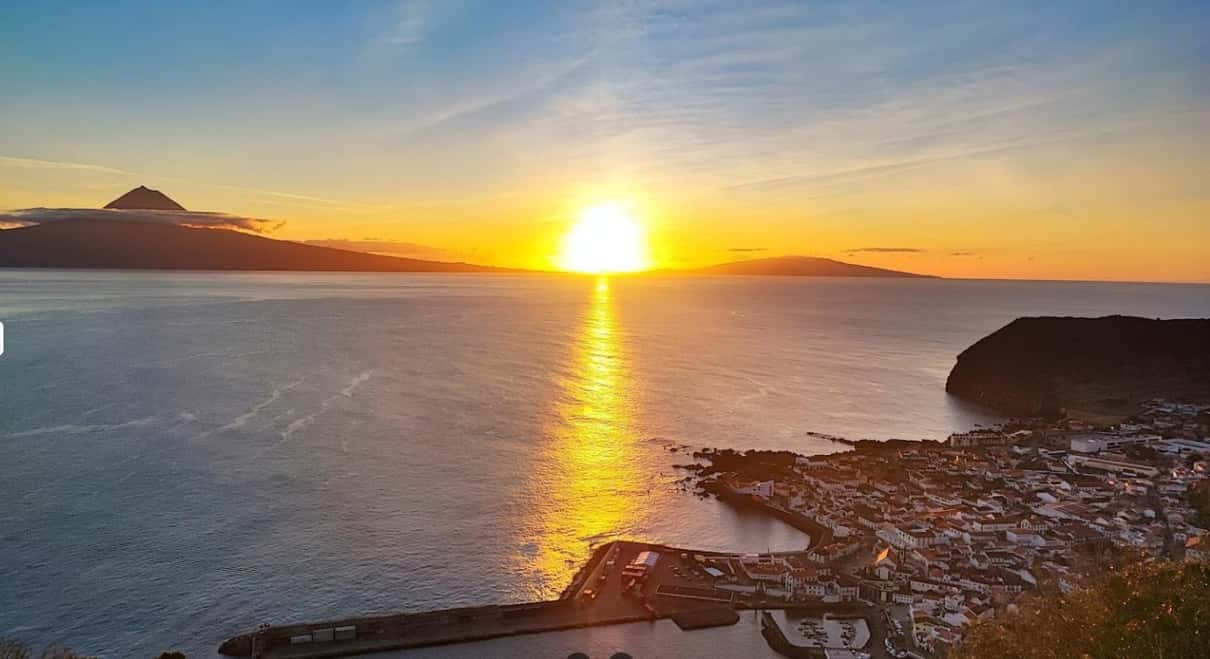
We arrived in Velas by ferry from São Roque on Pico. The approach gives you a useful first lesson in the Triangle Islands: Pico’s cone can sit across the channel while São Jorge’s cliffs rise abruptly in front of you.
Velas is compact, calm and logistically easy. The marina, supermarkets, cafés, car rentals and ferry port are close together, which is exactly why I still think it is the best base for most first-time visitors. My separate where to stay in São Jorge guide compares Velas with Urzelina, Calheta, the northern fajãs, Topo and Rosais.
Before driving out, I would walk the waterfront and stop at the Igreja Matriz de São Jorge. The town is not the island’s headline experience, but having an easy place to return to after slow mountain roads is worth more than it sounds.


Drive Velas → Manadas → Calheta Before Dropping Into the Fajãs
This is the part of the island where culture, food and scenery fit naturally into the same driving day.
Church of Santa Bárbara in Manadas
The Church of Santa Bárbara was one of the cultural stops that genuinely justified getting out of the car. The exterior is restrained; the interior is not. Gilded woodwork, painted surfaces and religious decoration make it feel unexpectedly rich for such a small settlement.
That contrast is exactly why I would include it. São Jorge can easily become an itinerary of cliffs, fajãs and viewpoints. Santa Bárbara prevents the island’s human history from disappearing behind the scenery.

Casa de Vigia and the road toward Calheta
Near Manadas, the old Casa de Vigia lookout is a reminder that these coastal roads once had a very different purpose. Continuing toward Calheta, low cloud frequently hangs against the green slopes, and I would resist the temptation to judge the day by whether every distant view is completely clear.

In Calheta, we stopped at a small bakery for São Jorge spice cake. This is exactly the sort of food stop I prefer on an island like this: something ordinary enough to belong to local life rather than a “culinary experience” invented for visitors.
Fajã dos Vimes: Drink Coffee Where It Grows
If you care about coffee, this is not a novelty stop. The location is the experience.
Fajã dos Vimes sits in a sheltered strip below the cliffs where the microclimate is mild enough for coffee plants. Official Azores tourism material specifically highlights the fajã’s coffee cultivation and the weaving tradition that survives alongside it.
At Café Nunes, I drank coffee grown in the fajã and saw the plants around the family operation. I love coffees from the edges of the coffee-growing world — places where geography itself makes you wonder how the crop ended up there — so this was one of my favorite food-and-place experiences anywhere in the Azores.
I would not oversell it as a cupping exercise for specialty-coffee obsessives chasing a score. What fascinated me was the complete context: tiny production, hand work, steep land, Atlantic air, local roasting, homemade sweets and a cup whose origin was visible a few steps away.
Fajã dos Vimes is also known for traditional weaving, so leave enough time to look beyond the coffee. This is one of the rare stops where a 20-minute “photo and drink” visit would miss the point.


Climb Back to Serra do Topo and Continue to the Eastern End
This stretch shows how rapidly São Jorge changes once you leave the protected fajãs and return to the ridge.
Around Serra do Topo, the road returns to the high interior. On a clear day, the island’s knife-like form becomes much easier to read: a green spine with slopes falling away toward both coasts.

At the far eastern end, Topo feels deliberately distant. The lighthouse and view toward Ilhéu do Topo are less dramatic than the cliff-bound fajãs, but that open, wind-exposed landscape is part of the contrast I wanted from the island.

Do not add Topo merely because it is “the end of the island”
I would keep it when you have two or three days and enjoy the road-trip rhythm. On a compressed one-day visit, Fajã dos Vimes and the north-coast highlights matter more to me than collecting the eastern endpoint.
Hike Serra do Topo → Fajã da Caldeira de Santo Cristo → Fajã dos Cubres
This is the experience I would protect rather than squeeze between driving stops.
The official PR01SJO route is a linear trail of about 9.3 km (5.8 mi), beginning around Serra do Topo, descending to Fajã da Caldeira de Santo Cristo and continuing along the coast to Fajã dos Cubres. Azores Trails rates it medium and lists an average walking time of about 2 hours 30 minutes.
I would allow more time than that if this is a highlight rather than a fitness test. The descent, waterfalls, Santo Cristo lagoon, settlement, coastal section and photo stops are the reason to be there. You also need to solve the linear-trail logistics: your car is not waiting at the finish unless you have arranged transport accordingly.
Before hiking, check the official Azores Trails page for current trail information. On a wet Atlantic island, a famous route is not worth treating as immutable.


São Jorge Island: Guided Hike to Caldeira de Santo Cristo
This is the tour I would choose if the hike is a priority but you do not want to solve the linear route, transfer logistics and navigation yourself. A guide also gives the geology and fajã settlement history more context than simply following a GPX line downhill.
Check Price & AvailabilityFajã do Ouvidor and Poça Simão Dias
The north coast is wilder, wetter and visually more enclosed than the south.
Fajã do Ouvidor descends toward one of the island’s best-known natural swimming areas. We stopped for fresh fish nearby before walking toward Poça Simão Dias, where dark lava walls shelter clear seawater.
I would not promise swimming merely because it appears on the itinerary. Sea conditions matter. If the water is rough, the pools are still a worthwhile landscape stop; if conditions are good, this is exactly where I would want unstructured time rather than another scheduled viewpoint.


São Jorge: Island, Forest Reserve & Fajãs Guided Tour
This suits travelers who want the road-trip version of São Jorge without spending the day navigating narrow roads and deciding which fajãs deserve the detour. I would choose this format over a hiking tour when viewpoints, villages and varied island scenery matter more than one major trail.
Check Price & AvailabilitySlow Down at Sete Fontes and São Jorge’s Western End
Day three is where I would stop optimizing the island and start enjoying the spaces between its headline sights.
Parque Florestal das Sete Fontes is a forest park of shaded paths, springs and dense vegetation on the western side of São Jorge. After steep coasts and exposed Atlantic viewpoints, I liked how gentle it felt.
It is not a reason to cross the whole island on a one-day visit. It becomes valuable once you have three days because the west can then be its own slower chapter rather than a final checkbox before racing back to Velas.


Stop at Urzelina, Then End With Pico Across the Channel
One ruined tower says more about the 1808 eruption than a long geological sidebar.
The Torre da Igreja da Urzelina is the surviving tower of a church destroyed during the 1808 eruption. I like stops like this because they make São Jorge’s volcanic history physical and immediate: the surrounding settlement continued, while one piece of the old church remained above the lava story.

Back in Velas, the view toward Pico is one of the simple pleasures of staying overnight rather than treating São Jorge as a transfer exercise. On a clear evening, the cone across the channel gives the Triangle Islands a sense of geography that you do not get from looking at ferry schedules.


Make Time for São Jorge Cheese, Not Just a Souvenir Wedge
Coffee is the unusual story. Cheese is the island-wide one.
Queijo São Jorge DOP/PDO is one of the island’s defining foods: a firm cow’s-milk cheese whose character becomes more pronounced with aging. We bought and tasted it during the trip, and the older versions are exactly the sort of assertive cheese I would seek out rather than defaulting to the mildest option.
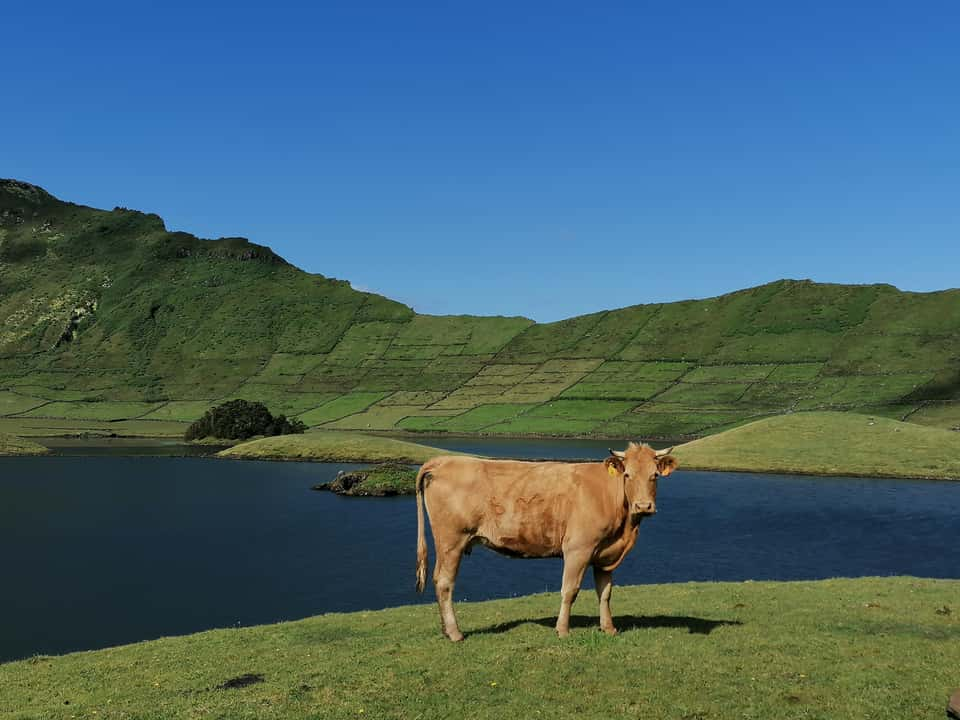
The island’s dairy economy is not a side attraction. Pastures cover huge parts of São Jorge, and the cheese connects that landscape directly with something you can taste. If you have three days, I think it deserves more than grabbing a vacuum-packed piece before the ferry.

São Jorge Cheese Tour – Half Day
I like this as a third-day option because it deepens something genuinely specific to São Jorge without duplicating the hiking or scenic-driving days. It is a better fit for food travelers than adding another generic viewpoint circuit.
Check Price & AvailabilityWhere to Stay on São Jorge
On this island, location can change the trip more than the hotel category.
Velas is still my default first-time base because the ferry port, restaurants, supermarket and car rentals remove friction. Urzelina gives you a more rural south-coast feel while staying reasonably close to Velas. Calheta reduces backtracking for eastern plans, while a northern fajã turns the landscape itself into the stay.
I would not use a remote fajã as the only base on a short first trip unless isolation is specifically the point. Read my complete guide to where to stay in São Jorge before choosing, because the road access and dining trade-offs matter much more here than the distance shown on Booking.com.

Compare São Jorge Hotels
Kuanza Nature Experience shows the atmospheric end of São Jorge accommodation, but I would compare the whole island for your dates and then use my area guide to decide whether the location helps or complicates your itinerary.
Browse São Jorge HotelsGetting to and Around São Jorge
The trip is simple once you make the transport decisions in the right order.
Ferry from Pico or Faial
Ferries are the natural way to connect São Jorge with Pico and Faial when seasonal schedules line up. We used the Pico–São Jorge route. Always check the current Atlânticoline timetable for your dates rather than planning around a generic “about an hour” crossing, because frequency and vessel type vary.
If you are bringing a vehicle, confirm that the specific sailing carries cars and reserve early in busy periods. For a short stay, I often prefer arranging a separate São Jorge rental rather than making the whole Triangle Islands itinerary depend on vehicle space on one sailing.
Flights
São Jorge also has inter-island flights. If the island sits between parts of the archipelago that do not connect neatly by ferry, flying can be the more rational answer. For broader island-hopping strategy, see my 2-week Azores itinerary.
Rental car
I strongly prefer a car for a multi-day independent São Jorge trip. Public transport is not designed around sightseeing stops, and the island’s weather rewards being able to change the order. If you are hiking Santo Cristo, remember that a rental car does not solve the linear-trail transfer by itself.

Compare Rental Cars on São Jorge
Book early if your dates fall in the busier months. São Jorge is not an island where I would want the vehicle choice to come down to whatever happens to remain at the counter after the ferry arrives.
Compare Rental CarsWeather, Trails and Mobile Data
São Jorge rewards flexibility more than rigid pre-booked sightseeing.
For a first trip, I favor May through September, especially when hiking is central. Even then, cloud can sit over Serra do Topo while a coastal fajã is perfectly usable. My best time to visit the Azores guide explains the wider seasonal trade-offs.
Trail status matters more than the month printed on your booking confirmation. Check official information before Santo Cristo, carry layers, and assume the surface can be wet even if Velas looks pleasant.
Mobile coverage can weaken below the cliffs, so I would download offline maps before driving or hiking. For data, see my Azores eSIM guide. If São Jorge is part of a wider Portugal trip, compare the Portugal eSIM options instead.
What I Would Book Before Arrival
São Jorge hotels
Small inventory means the location you want can disappear before the island is “sold out” overall.
Compare HotelsRental car
Especially important if you want two independent road-trip days rather than relying on taxis.
Compare CarsMobile data
I would set this up before the ferry or flight and still download offline maps for the fajãs.
Check Nomad eSIM PlansSmall Food Stops Matter on São Jorge
This island is better when you leave room for places that are not headline attractions.
In addition to coffee and aged São Jorge cheese, I would look for the local spice cake around Calheta, fresh fish on the north coast, clams associated with the Santo Cristo lagoon when available, and simple cafés in Velas rather than trying to turn every meal into a destination restaurant.
I especially enjoyed Apneia Bar for the combination of food and views. São Jorge is the sort of place where setting can make a straightforward meal more memorable than a highly engineered tasting menu.
Continue Planning the Azores

São Jorge Itinerary FAQ
Is São Jorge worth visiting?
Yes, especially if you value hiking, dramatic coastal landscapes, local food and places that still feel more lived-in than visitor-oriented. I would not add São Jorge merely to increase the island count, but I think it earns two or three days easily on a longer Azores trip.
Can you visit São Jorge as a day trip from Pico?
Yes when the ferry timetable gives you enough useful hours, but choose either a road-trip day or a hiking-focused day. I would not attempt the full Santo Cristo hike and a complete island loop before a fixed return ferry.
How many days should I spend on São Jorge?
Two days is my minimum for a satisfying first visit: one driving day and one hiking/north-coast day. Three days is better if you want the west, cheese, swimming, Velas and weather flexibility.
Do you need a car on São Jorge?
For an independent multi-day itinerary, I strongly prefer one. Organized tours are the easier alternative if you do not want to drive. The Santo Cristo hike is linear, so even with a car you still need to plan the start and finish logistics.
What is the best hike on São Jorge?
The Serra do Topo – Fajã da Caldeira de Santo Cristo – Fajã dos Cubres route is the headline trail for good reason. The official route is about 9.3 km (5.8 mi), linear and rated medium. Check current trail status before setting out.
Where can you drink São Jorge coffee?
Fajã dos Vimes is the key coffee-growing area. I visited Café Nunes, drank locally grown coffee and saw the small-scale production around the fajã. For me as a coffee lover, it was one of São Jorge’s most distinctive experiences.
Where should I stay on São Jorge?
Velas is the easiest first-time base. Urzelina gives you countryside without extreme isolation, Calheta is useful for eastern plans, and the northern fajãs are for travelers who want the landscape to become part of the stay. My dedicated accommodation guide compares all of them.
When is the best time to visit São Jorge?
I would favor May through September for a first visit, particularly if hiking is important. June and September are especially attractive to me because they usually balance usable weather with less peak-season pressure than August.
Do Less Per Day and the Island Gives You More Back
São Jorge is not difficult to visit. It is difficult to rush well. Separate the hiking day from the road-trip day, leave room for coffee, cheese and weather, and the island stops feeling like a list of fajãs and starts feeling like one coherent place.
Sleeping on São Jorge?
Choose the base around the part of the island you want outside your door, then compare hotels for the actual dates.
Compare São Jorge Bases Browse São Jorge HotelsBuilding an island-hopping route?
Put São Jorge beside Pico and Faial, but give it enough time to be more than a ferry excursion.
See My 2-Week Azores Route Continue to PicoLast Updated on 08/10/2026 by Panos


